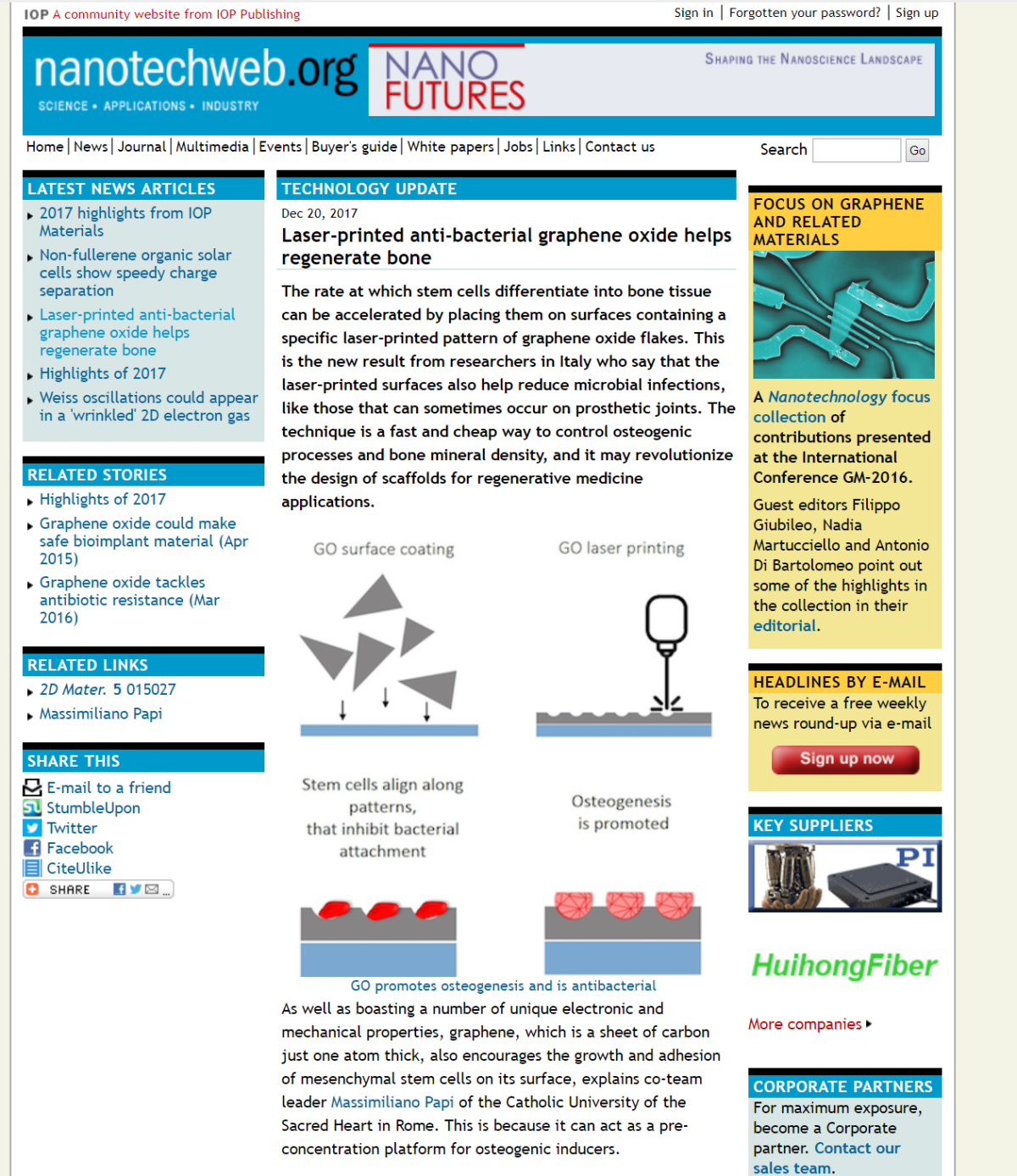
Impressive Web-impact of the graphene 3D bone-printing !

Web-Press release on graphene for 3D bone-printing

https://www.cnr.it/it/comunicato-stampa/7895/foglietti-di-grafene-come-stampi-per-costruire-nuove-protesi-ossee-personalizzate

http://www.vivienna.it/2018/01/25/foglietti-di-grafene-come-stampi-per-costruire-nuove-protesi-ossee-personalizzate/

https://agensir.it/quotidiano/2018/1/24/ricerca-scientifica-universita-cattolicacnr-sviluppati-foglietti-di-grafene-come-stampi-per-costruire-nuove-protesi-ossee-personalizzate/

http://www.popsci.it/protesi-osseein-futuro-saranno-con-foglietti-di-grafene.html

https://isnello.virgilio.it/notizielocali/foglietti_di_grafene_come_stampi_per_costruire_nuove_protesi_ossee_personalizzate-54268140.html

http://www.adnkronos.com/soldi/economia/2018/01/24/grafene-arrivo-protesi-ossee-tessuti-antifiamma_S23zoadjJRR2FB1Ts5dgYO.html

Ricerca, foglietti di grafene per la stampa di protesi ossee su misura

http://www.agenziarepubblica.it/foglietti-grafene-stampi-costruire-nuove-protesi-ossee-personalizzate/

http://www.lescienze.it/lanci/2018/01/24/news/cnr_foglietti_di_grafene_come_stampi_per_costruire_nuove_protesi_ossee_personalizzate-3833161/

Download  web-press-release here :  CNR Web Release

Download full web-press-release (33MB) :  CNR Web Release full

QUANTERA project QUOMPLEX funded!

The project QUOMPLEX authored by Mehul Malik (Coordinator), Pepijn Pinske and Claudio Conti is among the 26 excellent international proposals in the field of quantum technologies research recommended for funding in the QUANTERA call 2017, the first step of the Quantum Technologies flagship.

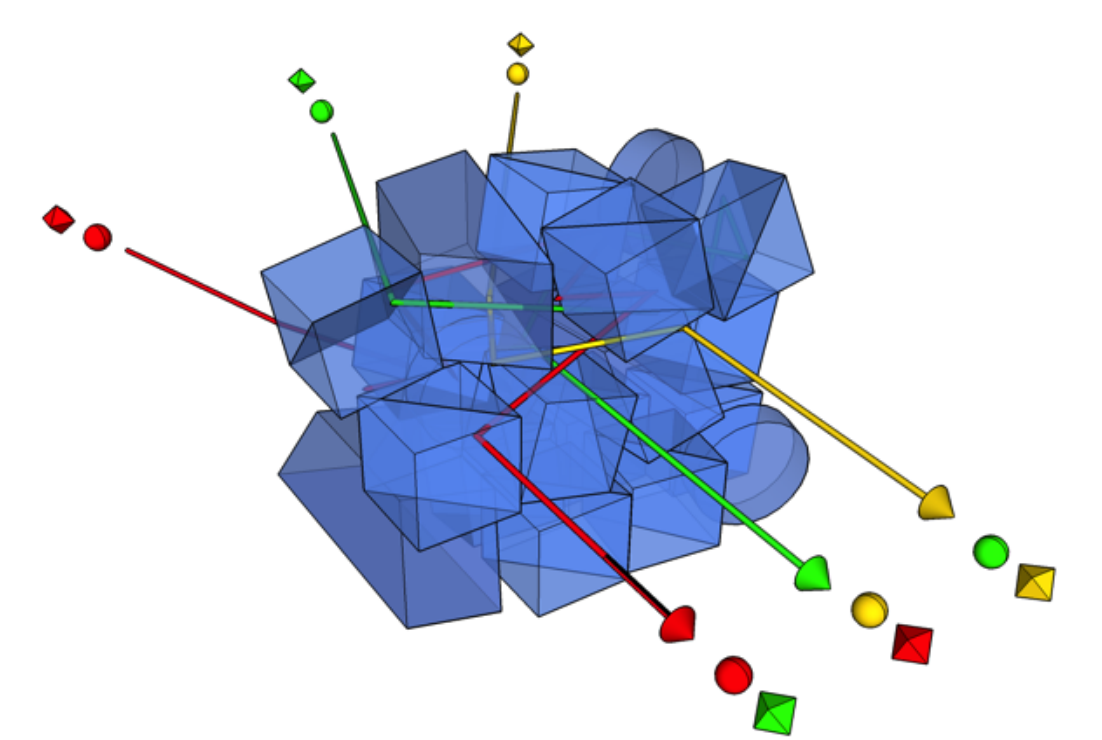
QUOMPLEX aims at harnessing random media, multi-modal propagation and machine learning for novel compact multi-level quantum gates.

QuantERA in Cordis (grant number 731473)

Website of the Quomplex Project

Stay tuned!

2D Materials paper: Laser printing of Graphene Surfaces for Bone Tissue Regeneration

Graphene and Graphene oxide (GO) are capable of inducing stem cells differentiation into bone tissue with variable efficacy depending on reductive state of the material. Thus, modulation of osteogenic process and of bone mineral density distribution is theoretically possible by controlling the GO oxidative state. In this study, we laser-printed GO surfaces in order to obtain both a local photo-thermal GO reduction and the formation of nano-wrinkles along precise geometric pattern. Initially, after cells adhered on the surface, stem cells migrated and accumulated on the reduced and wrinkled surface. When the local density of the stem cells on the reduced stripes was high, cells started to proliferate and occupy the oxidized/flat area. The designed surfaces morphology guided stem cell orientation and the reduction accelerated differentiation. Furthermore the reduced sharp nano-wrinkles were able to enhance the GO antibacterial activity against Methicillin-resistant Staphylococcus aureus (MRSA), common cause of prosthetic joints infections. This strategy can offer a revolution in present and future trends of scaffolds design for regenerative medicine.

Palmieri, V., Barba, M., Pietro, L.D., Gentilini, S., Braidotti, M.C., Ciancico, C., Bugli, F., Ciasca, G., Larciprete, R., Lattanzi, W., Sanguinetti, M., Spirito, M.D., Conti, C., Papi, M. (2017) “Reduction and shaping of graphene-oxide by laser-printing for controlled bone tissue regeneration and bacterial killing”2D Materials 

See also

http://www.newcomplexlight.org/nanotechweb-org-on-laser-printed-bone-tissue-by-graphene/