Degree-of-polarization modulation for high-dimensional optical computing

Nature (2026-08-12) https://doi.org/10.1038/s41586-026-10891-z

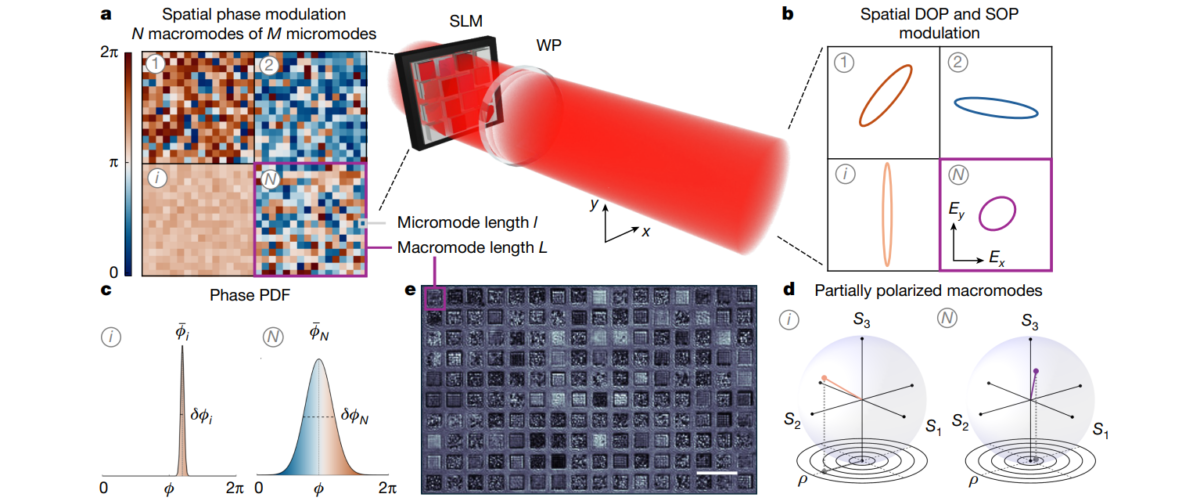
Spatial light modulation is a cornerstone of modern photonics. Crucial advances in photonic information processing rely on the spatial manipulation of the optical phase and state of polarization (SOP). The degree of polarization (DOP) is a fundamental property that can serve as an extra resource. However, no technology exists at present that can spatially modulate the DOP in a programmable manner. Here we demonstrate spatial DOP modulation, thereby achieving control over a new degree of freedom of light. By engineering the polarization statistics at the micrometre scale with a phase-only spatial light modulator, we realize more than 1,024 spatial
modes with fully programmable SOP and DOP. This structured light, sculpted in its polarization content to arbitrary shapes, enables direct encoding of information in a high-dimensional space. We encode colour images into a single-wavelength laser by using a one-to-one mapping between the red–green–blue space and the volume of the
Poincaré sphere. Polarization colours expand the dimensionality of optical computing and encryption schemes, as demonstrated by (1) fully parallel photonic classification of colour images by a high-dimensional photonic neural network and (2) high-security multidimensional optical encryption. These approaches to optical processing of high-dimensional data highlight the opportunities enabled by DOP modulation in photonics, cryptography and computing.

Optical Spin Glasses

https://opg.optica.org/aop/abstract.cfm?URI=aop-18-2-421

Spin-glass theory emerged in the 1980s as a merger between theoretical physics and condensed matter. Soon, physicists realized that spin glasses serve as a paradigm for complex systems, as underscored by the 2021 Nobel Prize in Physics, and for applications in machine learning and neuroscience, with a profound connection with the Hopfield model and Boltzmann machines, subjects of the 2024 Nobel Prize in Physics. However, the connection with optics and photonics is even more profound and fundamental; this connection was identified as early as 1982, with the first realizations of optical neural networks. Thirty years later, the first experimental demonstration of a pillar of spin-glass theory, the replica symmetry breaking, was reported in photonics. Nowadays, many scientists consider photonics as an effective solution for new hardware in artificial intelligence, capable of reducing energy consumption in training large machine-learning modules, and also more suitable for realizing fully connected models that underpin modern data-driven analysis. The substantial equivalence between linear optical propagation and a system of interacting binary spins is now well recognized, triggering the development of a new family of devices for both classical and quantum computing. This review is intended to detail the work of the past twenty years concerning the link between spin-glass theory and optics. After a simple introduction to the main ideas of spin glasses, we start from the first works aimed at finding a direct experimental proof of ideas such as the landscape and ultrametricity; then we report on “linear optical spin glasses,” which refer to the photonic simulation of various Ising models for combinatorial optimization and interlinked with quantum computers; finally, we discuss the emerging field of “nonlinear optical spin glasses,” driven by the impressive progress in the realization of coherent Ising machines with parametric oscillators, that opened an new research direction driven by the cross-fertilization of advanced theoretical physics, artificial intelligence, classical and quantum nonlinear optics.

Ising Machine by Dimensional Collapse of Nonlinear Polarization Oscillators

https://journals.aps.org/prl/abstract/10.1103/qs29-2xqc

Phys. Rev. Lett. 135, 063801 – Published 4 August, 2025

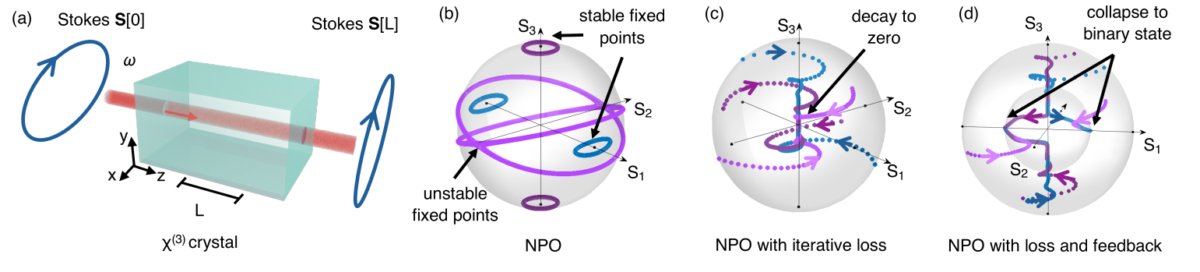
Ising machines show promise as ultrafast hardware for optimizations encoded in Ising Hamiltonians but fall short in terms of success rate and performance scaling. Here, we propose a novel Ising machine that exploits the three-dimensional nature of nonlinear polarization oscillators to counteract these limitations. Based on the evolution of the optical polarization in third-order nonlinear media, the high-dimensional machine reaches the Ising ground state by the mechanism of “dimensional collapse”: the dynamics on the Poincaré sphere undergoes a self-induced collapse into polarization fixed points mapping an Ising spin. Collapse from a spherical to a binary spin occurs when the polarization oscillator experiences iterative loss and anisotropic feedback. The photonic setup consists of polarization modulated pulses in a 𝜒(3) crystal subject to measurement and feedback. We numerically demonstrate the polarization machine achieves enhanced success probability on benchmark graphs and an exponential improvement in performance scaling with respect to coherent Ising machines due to its high-dimensional operation. The proposed Ising machine paves the way for a new class of Ising solvers with enhanced computing capabilities.

Equalized Hyperspin Machine

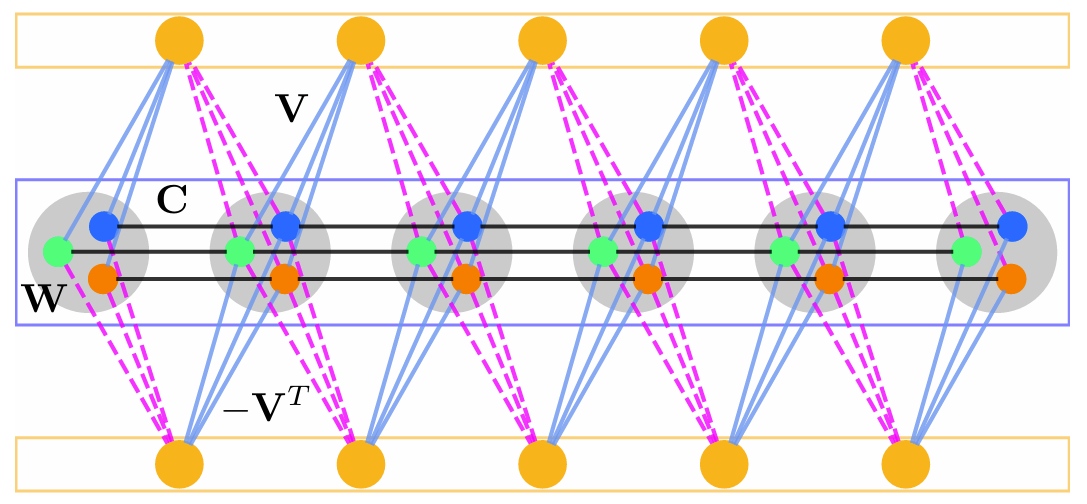
The reliable simulation of spin models is of critical importance to tackle complex optimization problems that are intractable on conventional computing machines. The recently introduced hyperspin machine, which is a network of linearly and nonlinearly coupled parametric oscillators, provides a versatile simulator of general classical vector spin models in arbitrary dimension, finding the minimum of the simulated spin Hamiltonian and implementing novel annealing algorithms. In the hyperspin machine, oscillators evolve in time minimizing a cost function that must resemble the desired spin Hamiltonian in order for the system to reliably simulate the target spin model. This condition is met if the hyperspin amplitudes are equal in the steady state. Currently, no mechanism to enforce equal amplitudes exists. Here, we bridge this gap and introduce a method to simulate the hyperspin machine with equalized amplitudes in the steady state. We employ an additional network of oscillators (named equalizers) that connect to the hyperspin machine via an antisymmetric nonlinear coupling and equalize the hyperspin amplitudes. We demonstrate the performance of such an equalized hyperspin machine by large-scale numerical simulations up to 10000 hyperspins. Compared to the hyperspin machine without equalization, we find that the equalized hyperspin machine (i) Reaches orders of magnitude lower spin energy, and (ii) Its performance is significantly less sensitive to the system parameters. The equalized hyperspin machine offers a competitive spin Hamiltonian minimizer and opens the possibility to combine amplitude equalization with complex annealing protocols to further boost the performance of spin machines.

[2507.12940] Equalized Hyperspin Machine

Phys. Rev. A 112, 053505 (2025)