Non-Abelian Quantum Walk and Entanglement

https://arxiv.org/abs/2412.02429

Non-Abelian evolution is a landmark in modern theoretical physics. However, whether non-commutative dynamics significantly impact the control of entanglement and transport in quantum systems is an open question. Here, we propose to utilize non-Abelian Thouless pumping in one-dimensional discrete-time quantum walks in lattices with degenerate Bloch bands. We show how the interplay of non-commutativity and topology enables geometrically protected quantum coins and shift operators. Different classes of tunable protected quantum walks arise by composing different non-Abelian pumping cycles. Surprisingly, the walks break parity symmetry and generate a dynamic process described by a Weyl-like equation. The amount of entanglement can be varied by acting on the initial conditions. The asymptotic statistical distribution and features are determined by closed-form analytical expressions and confirmed numerically.

Mathstodon https://mathstodon.xyz/@nonlinearxwaves/113610374997139049

Observation of terahertz transition from Fano resonances to bound states in the continuum

Bound states in the continuum (BIC) in metamaterials have recently attracted attention for their promising applications in photonics. Here, we investigate the transition from Fano resonances to BIC, at terahertz (THz) frequencies, of a one-dimensional photonic crystal slab made of rectangular dielectric rods. Simulations performed by an analytical exact solution of the Maxwell equations showed that symmetry-protected, high-quality factor (Q), BIC emerge at normal incidence. For non-normal incidence, BIC couple with the freely propagating waves and appear in the scattering field as a Fano resonance. Simulations were verified by realizing the photonic crystal slab by 3D-printing technique. THz time-domain spectroscopy measurements as a function of the incidence angle matched the simulation to good accuracy and confirmed the evolution of Fano resonances to high-Q resonances typical of BIC. These results point out the design of highly sensitive and low-cost THz devices for sensing for a wide range of applications.

https://doi.org/10.1364/OL.486226

Experiments confirm the Non-Abelian Thouless pumping !

Sun et al. in Nature Physics recently reported the experimental observation of the Non-Abelian Thouless pumping by Brosco et al. in Physical Review A.

See also

The experiments in Nature Physics: https://www.nature.com/articles/s41567-022-01669-x

The News and Views by Brosco and Pilozzi :

https://www.nature.com/articles/s41567-022-01675-z

Nonlocality-induced surface localization in Bose-Einstein condensates of light

The ability to create and manipulate strongly correlated quantum many-body states is of central importance to the study of collective phenomena in several condensed-matter systems. In the last decades, a great amount of work has been focused on ultracold atoms in optical lattices, which provide a flexible platform to simulate peculiar phases of matter both for fermionic and bosonic particles. The recent experimental demonstration of Bose-Einstein condensation (BEC) of light in dye-filled microcavities has opened the intriguing possibility to build photonic simulators of solid-state systems, with potential advantages over their atomic counterpart. A distinctive feature of photon BEC is the thermo-optical nature of the effective photon-photon interaction, which is intrinsically nonlocal and can thus induce interactions of arbitrary range. This offers the opportunity to systematically study the collective behavior of many-body systems with tunable interaction range. In this paper, we theoretically study the effect of nonlocal interactions in photon BEC. We first present numerical results of BEC in a double-well potential, and then extend our analysis to a short one-dimensional lattice with open boundaries. By resorting to a numerical procedure inspired by the Newton-Raphson method, we simulate the time-independent Gross-Pitaevskii equation and provide evidence of surface localization induced by nonlocality, where the condensate density is localized at the boundaries of the potential. Our work paves the way toward the realization of synthetic matter with photons, where the interplay between long-range interactions and low dimensionality can lead to the emergence of unexplored nontrivial collective phenomena.

https://doi.org/10.1103/PhysRevA.105.043318

The hyperspin machine: simulating QCD models and dimensional annealing

https://arxiv.org/abs/2203.16190

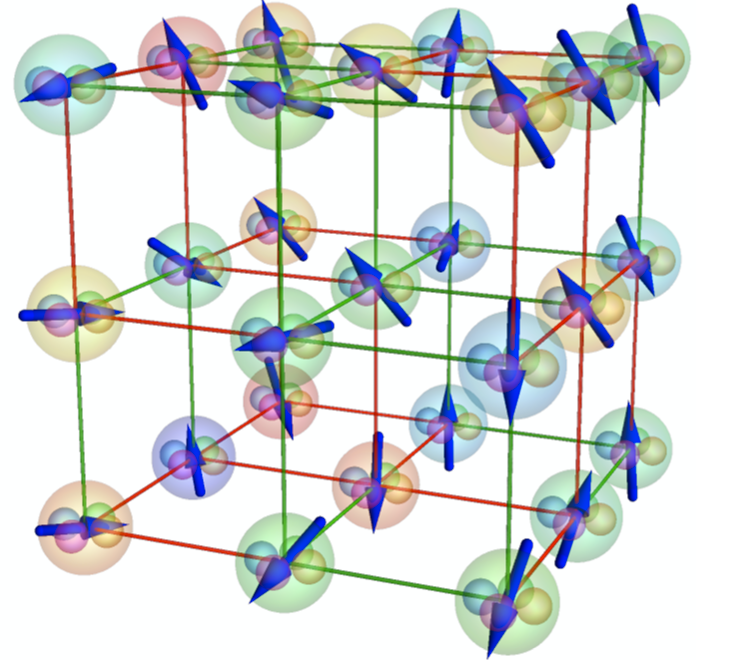
From condensed matter to quantum chromodynamics, multidimensional spins are a fundamental paradigm, with a pivotal role in combinatorial optimization and machine learning. Machines formed by coupled parametric oscillators can simulate spin models, but only for Ising or low-dimensional spins. Currently, machines implementing arbitrary dimensions remain a challenge. Here, we introduce and validate a hyperspin machine to simulate multidimensional continuous spin models. We realize high-dimensional spins by pumping groups of parametric oscillators, and study NP-hard graphs of hyperspins. The hyperspin machine can interpolate between different dimensions by tuning the coupling topology, a strategy that we call “dimensional annealing”. When interpolating between the XY and the Ising model, the dimensional annealing impressively increases the success probability compared to conventional Ising simulators. Hyperspin machines are a new computational model for combinatorial optimization. They can be realized by off-the-shelf hardware for ultrafast, large-scale applications in classical and quantum computing, condensed-matter physics, and fundamental studies.