An inequality for relativistic local quantum measurements

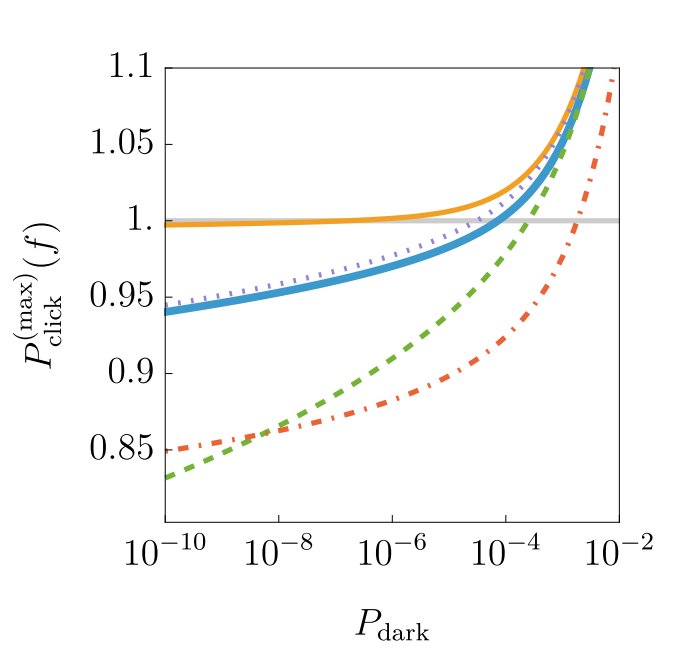
We investigate the trade-off between vacuum insensitivity and sensitivity to excitations in finite-size detectors, taking measurement locality as a fundamental constraint. We derive an upper bound on the detectability of vacuum excitation, given a small but nonzero probability of false positives in the vacuum state. The result is independent of the specific details of the measurement or the underlying physical mechanisms of the detector and relies only on the assumption of locality. Experimental confirmation or violation of the inequality would provide a test of the axioms of algebraic quantum field theory, offer new insights into the measurement problem in relativistic quantum physics, and establish a fundamental technological limit in local particle detection.

https://arxiv.org/abs/2509.11599

Reeh-Schlieder approximation for coherent states

We present an explicit, fully local Reeh-Schlieder approximation scheme for coherent states of a free scalar field. For any bounded region U, we construct a one-parameter family of bounded operators A^ζ localized in the causal complement of U. The action of A^ζ on the vacuum approximates the target coherent state in the limit ζ→0.

Emergent Equilibrium in All-Optical Single Quantum-Trajectory Ising Machines

We investigate the dynamics of multi-mode optical systems driven by two-photon processes and subject to non-local losses, incorporating quantum noise at the Gaussian level. Our findings show that the statistics from a single Gaussian quantum trajectory exhibit emergent thermal equilibrium governed by an Ising Hamiltonian encoded in the dissipative coupling between modes. The driving strength sets the system’s effective temperature relative to the oscillation threshold. Given the ultra-short time scales typical of all-optical devices, our study demonstrates that such multi-mode optical systems can operate as ultra-fast Boltzmann samplers, paving the way toward the realization of efficient hardware for combinatorial optimization, with promising applications in machine learning and beyond.

https://arxiv.org/abs/2412.12768

https://mathstodon.xyz/@nonlinearxwaves/113672283856089363

Non-Abelian Quantum Walk and Entanglement

https://arxiv.org/abs/2412.02429

Non-Abelian evolution is a landmark in modern theoretical physics. However, whether non-commutative dynamics significantly impact the control of entanglement and transport in quantum systems is an open question. Here, we propose to utilize non-Abelian Thouless pumping in one-dimensional discrete-time quantum walks in lattices with degenerate Bloch bands. We show how the interplay of non-commutativity and topology enables geometrically protected quantum coins and shift operators. Different classes of tunable protected quantum walks arise by composing different non-Abelian pumping cycles. Surprisingly, the walks break parity symmetry and generate a dynamic process described by a Weyl-like equation. The amount of entanglement can be varied by acting on the initial conditions. The asymptotic statistical distribution and features are determined by closed-form analytical expressions and confirmed numerically.

Mathstodon https://mathstodon.xyz/@nonlinearxwaves/113610374997139049

Quantum Hyperspins: A New Schroedinger’s Cat ?

https://arxiv.org/abs/2411.05728

We report on the emergence of a highly non-classical collective behavior in quantum parametric oscillators, which we name quantum hyperspin, induced by a tailored nonlinear interaction. This is the second quantized version of classical multidimensional spherical spins, as XY spins in two dimensions and Heisenberg spins in three dimensions. In the phase space, the quantum hyperspins are represented as spherical shells whose radius scales with the number of particles in a way such that it cannot be factorized even in the limit of large particle number. We show that the nonlinearly coupled quantum oscillators form a high-dimensional entangled state that is surprisingly robust with respect to the coupling with the environment. Such a behavior results from a properly engineered reservoir. Networks of entangled quantum hyperspins are a new approach to quantum simulations for applications in computing, Ising machines, and high-energy physics models. From first principles through ab initio numerical simulations, we analyze the properties of quantum hyperspins, including the interplay of entanglement and coupling frustration.

Quantum hyperspins: Highly nonclassical collective behavior in quantum optical parametric oscillators

https://journals.aps.org/pra/abstract/10.1103/PhysRevA.111.043712

https://mathstodon.xyz/@nonlinearxwaves/113462588899837887