

We investigate the dynamics of multi-mode optical systems driven by two-photon processes and subject to non-local losses, incorporating quantum noise at the Gaussian level. Our findings show that the statistics from a single Gaussian quantum trajectory exhibit emergent thermal equilibrium governed by an Ising Hamiltonian encoded in the dissipative coupling between modes. The driving strength sets the system’s effective temperature relative to the oscillation threshold. Given the ultra-short time scales typical of all-optical devices, our study demonstrates that such multi-mode optical systems can operate as ultra-fast Boltzmann samplers, paving the way toward the realization of efficient hardware for combinatorial optimization, with promising applications in machine learning and beyond.
Category: Machine Learning
Fully Programmable Spatial Photonic Ising Machine by Focal Plane Division

https://arxiv.org/abs/2410.10689
Ising machines are an emerging class of hardware that promises ultrafast and energy-efficient solutions to NP-hard combinatorial optimization problems. Spatial photonic Ising machines (SPIMs) exploit optical computing in free space to accelerate the computation, showcasing parallelism, scalability, and low power consumption. However, current SPIMs can implement only a restricted class of problems. This partial programmability is a critical limitation that hampers their benchmark. Achieving full programmability of the device while preserving its scalability is an open challenge. Here, we report a fully programmable SPIM achieved through a novel operation method based on the division of the focal plane. In our scheme, a general Ising problem is decomposed into a set of Mattis Hamiltonians, whose energies are simultaneously computed optically by measuring the intensity on different regions of the camera sensor. Exploiting this concept, we experimentally demonstrate the computation with high success probability of ground-state solutions of up to 32-spin Ising models on unweighted maximum cut graphs with and without ferromagnetic bias. Simulations of the hardware prove a favorable scaling of the accuracy with the number of spins. Our fully programmable SPIM enables the implementation of many quadratic unconstrained binary optimization problems, further establishing SPIMs as a leading paradigm in non von Neumann hardware.
HEISINGBERG presentation on YouTube

Deep Learning Enabled Transmission of Full-Stokes Polarization Images Through Complex Media

Polarization images offer crucial functionalities across multiple scientific domains, providing access to physical information beyond conventional measures such as intensity, phase, and spectrum of light. However, the challenge of transmitting polarization images through complex media has restricted their application in optical communication and imaging. Here, a novel approach utilizing deep learning for the transmission of full-Stokes polarization images through scattering media is presented. It is demonstrated that any input polarization image can be reconstructed in a single shot by employing only an intensity sensor. By supervised training of a deep neural network, high-accuracy full-Stokes reconstruction is achieved from the speckle pattern detected by an intensity camera. Leveraging the deep learning based polarization decoder, a polarization-colored encoding scheme is devised to enable increased-capacity data transmission through disordered channels. Fast, wavelength-independent, on-chip, polarization imaging in complex media enables the utilization of polarization-structured light in multimode fibres and opaque materials, unlocking new possibilities in optical communication, cryptography, and quantum technology.
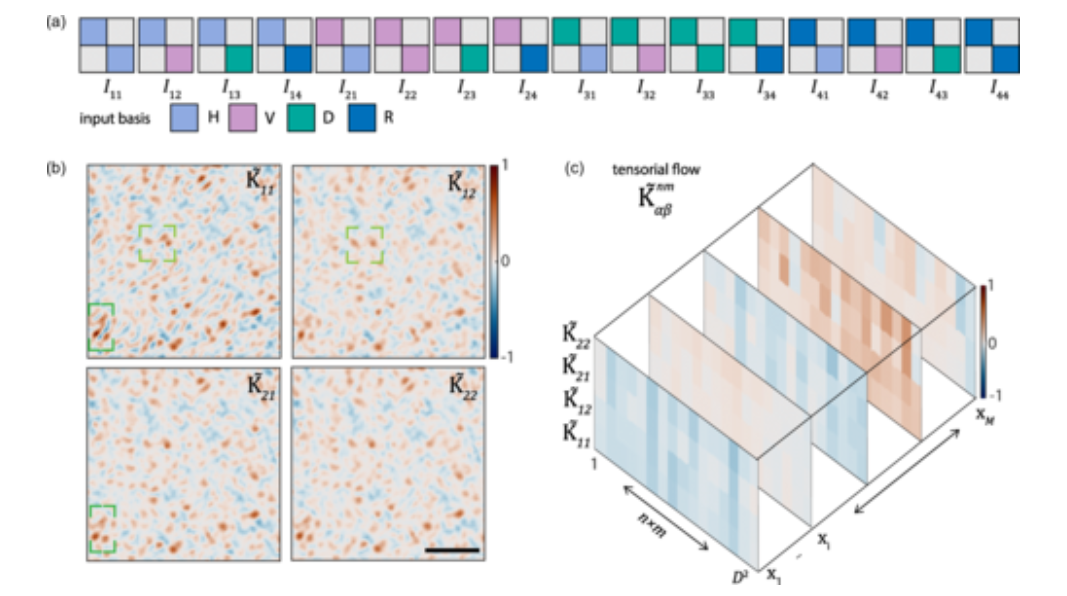
Tensorial flow of mosaic beams in PRL !
https://journals.aps.org/prl/abstract/10.1103/PhysRevLett.132.243801
Optical beams with nonuniform polarization offer enhanced capabilities for information transmission, boasting increased capacity, security, and resilience. These beams possess vectorial features that are spatially organized within localized three-dimensional regions, forming tensors that can be harnessed across a spectrum of applications spanning quantum physics, imaging, and machine learning. However, when subjected to the effect of the transmission channel, the tensorial propagation leads to a loss of data integrity due to the entanglement of spatial and polarization degrees of freedom. The challenge of quantifying this spatial-polarization coupling poses a significant obstacle to the utilization of vector beams in turbulent environments, multimode fibers, and disordered media. Here, we introduce and experimentally investigate mosaic vector beams, which consist of localized polarization tesserae that propagate in parallel, demonstrating accurate measurement of their behavior as they traverse strongly disordered channels and decoding their polarization structure in single-shot experiments. The resultant transmission tensor empowers polarization-based optical communication and imaging in complex media. These findings also hold promise for photonic machine learning, where the engineering of tensorial flow can enable optical computing with high throughput.