Topological nanophotonics and artificial neural networks

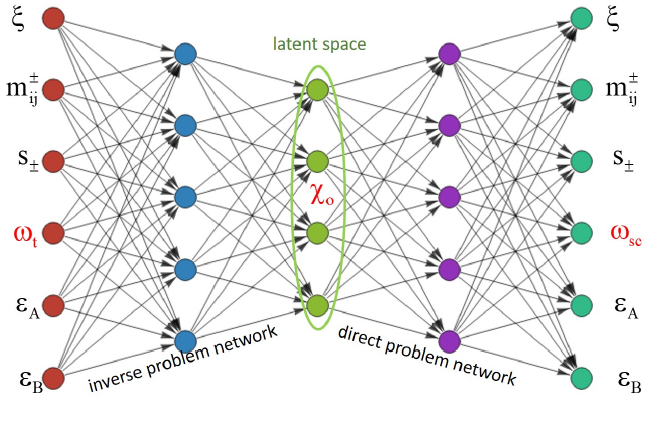
We propose the use of artificial neural networks to design and characterize photonic topological insulators. As a hallmark, the band structures of these systems show the key feature of the emergence of edge states, with energies lying within the energy gap of the bulk materials and localized at the boundary between regions of distinct topological invariants. We consider different structures such as one-dimensional photonic crystals, PT-symmetric chains and cylindrical systems and show how, through a machine learning application, one can identify the parameters of a complex topological insulator to obtain protected edge states at target frequencies. We show how artificial neural networks can be used to solve the long standing quest of inverse-problems solution and apply it to the cutting edge topic of topological nanophotonics.

Pilozzi et al 2020 Nanotechnology https://doi.org/10.1088/1361-6528/abd508
Multidimensional topological strings

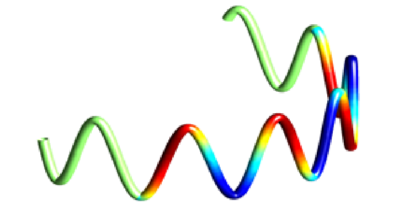
By considering a cigar-shaped trapping potential elongated in a proper curvilinear coordinate, we discover a new form of wave localization that arises from the interplay of geometry and topological protection. The potential is modulated in its shape such that local curvature introduces a trapping potential. The curvature varies along the trap curvilinear axis encodes a topological Harper modulation. The varying geometry maps our system in a one-dimensional Andre-Aubry-Harper grating. We show that a mobility edge exists with topologically protected states. These modes are extremely robust with respect to disorder in the shape of the string. The results may be relevant for localization phenomena in Bose-Einstein condensates, optical fibers and waveguides, and new laser devices, but also for fundamental studies on string theory. Taking into account that the one-dimensional modulation mimics the existence of an additional dimension, our system is the first example of a physically realizable five-dimensional string.

arXiv:2002.03091

Simulating general relativity and non-commutative geometry by nonparaxial quantum fluids

We show that quantum fluids enable experimental analogs of relativistic orbital precession in the presence of non-paraxial effects. The analysis is performed by the hydrodynamic limit of the Schroedinger equation. The non-commutating variables in the phase-space produce a precession and an acceleration of the orbital motion. The precession of the orbit is formally identical to the famous orbital precession of the perihelion of Mercury used by Einstein to validate the corrections of general relativity to Newton’s theory. In our case, the corrections are due to the modified uncertainty principle. The results may enable novel relativistic analogs in the laboratory, also including sub Planckian phenomenology.

https://iopscience.iop.org/article/10.1088/1367-2630/ab5da8
