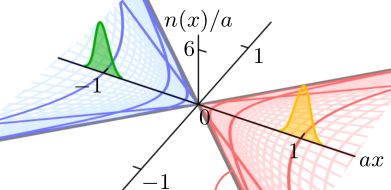
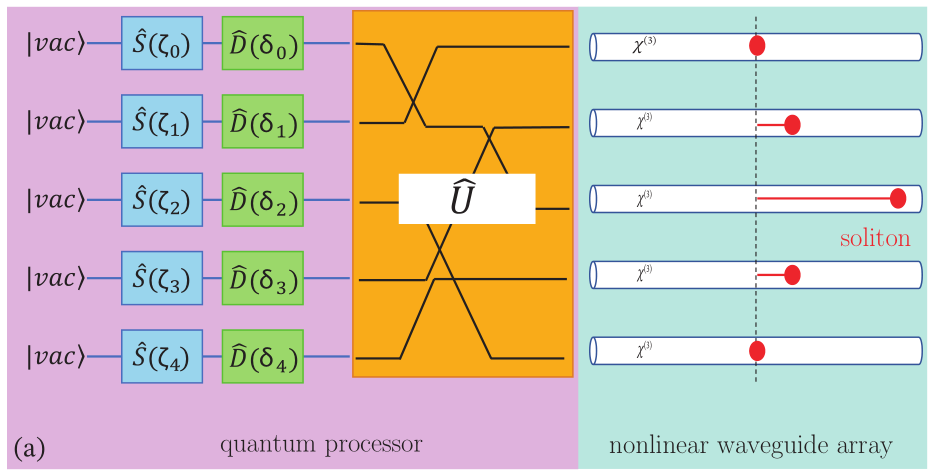
The ability to create and manipulate strongly correlated quantum many-body states is of central importance to the study of collective phenomena in several condensed-matter systems. In the last decades, a great amount of work has been focused on ultracold atoms in optical lattices, which provide a flexible platform to simulate peculiar phases of matter both for fermionic and bosonic particles. The recent experimental demonstration of Bose-Einstein condensation (BEC) of light in dye-filled microcavities has opened the intriguing possibility to build photonic simulators of solid-state systems, with potential advantages over their atomic counterpart. A distinctive feature of photon BEC is the thermo-optical nature of the effective photon-photon interaction, which is intrinsically nonlocal and can thus induce interactions of arbitrary range. This offers the opportunity to systematically study the collective behavior of many-body systems with tunable interaction range. In this paper, we theoretically study the effect of nonlocal interactions in photon BEC. We first present numerical results of BEC in a double-well potential, and then extend our analysis to a short one-dimensional lattice with open boundaries. By resorting to a numerical procedure inspired by the Newton-Raphson method, we simulate the time-independent Gross-Pitaevskii equation and provide evidence of surface localization induced by nonlocality, where the condensate density is localized at the boundaries of the potential. Our work paves the way toward the realization of synthetic matter with photons, where the interplay between long-range interactions and low dimensionality can lead to the emergence of unexplored nontrivial collective phenomena.
https://doi.org/10.1103/PhysRevA.105.043318