Tsunami of light launched against 3D-printed tumor cells

Nature Communications 14, 4662 (2023)

Extreme waves are intense and unexpected wavepackets ubiquitous in complex systems. In optics, these rogue waves are promising as robust and noise-resistant beams for probing and manipulating the underlying material. Localizing large optical power is crucial especially in biomedical systems, where, however, extremely intense beams have not yet been observed. We here discover that tumor-cell spheroids manifest optical rogue waves when illuminated by randomly modulated laser beams. The intensity of light transmitted through bio-printed three-dimensional tumor models follows a signature Weibull statistical distribution, where extreme events correspond to spatially-localized optical modes propagating within the cell network. Experiments varying the input beam power and size indicate that the rogue waves have a nonlinear origin. We show that these nonlinear optical filaments form high-transmission channels with enhanced transmission. They deliver large optical power through the tumor spheroid, and can be exploited to achieve a local temperature increase controlled by the input wave shape. Our findings shed light on optical propagation in biological aggregates and demonstrate how nonlinear extreme event formation allows light concentration in deep tissues, paving the way to using rogue waves in biomedical applications, such as light-activated therapies.

Dark matter condensates as highly nonlocal solitons: instability in the Schwarzschild metric and laboratory analog

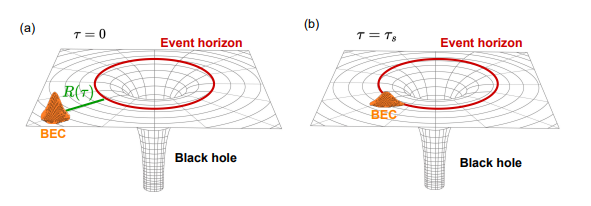
Theories on the bosonic nature of dark matter are a promising alternative to the cold dark matter model. Here we consider a dark matter halo in the state of a Bose-Einstein condensate, subject to the gravitation of a black hole. In the low energy limit, we bring together the general relativity in the Schwarzschild metric and the quantum description of the Bose-Einstein condensate. The model is solvable in the Fermi normal coordinates with the so called highly nonlocal approximation and describes tidal deformations in the condensate wave function. The black hole deforms the localized condensate until the attraction of the compact object overcomes the self-gravitation and destabilizes the solitonic dark matter. Moreover, the model can be implemented as a gravitational analog in the laboratory; the time-dependent potential generated by the galactic black hole can be mimicked by an optical trap acting on a conventional condensate. The results open the way to new laboratory simulators for quantum gravitational effects.

https://arxiv.org/abs/2305.10780

Biosensing with free space whispering gallery mode microlasers

Highly accurate biosensors for few or single molecule detection play a central role in numerous key fields, such as healthcare and environmental monitoring. In the last decade, laser biosensors have been investigated as proofs of concept, and several technologies have been proposed. We here propose a demonstration of polymeric whispering gallery microlasers as biosensors for detecting small amounts of proteins down to 400 pg. They have the advantage of working in free space without any need for waveguiding for input excitation or output signal detection. The photonic microsensors can be easily patterned on microscope slides and operate in air and solution. We estimate the limit of detection up to 148 nm/RIU for three different protein dispersions. In addition, the sensing ability of passive spherical resonators in the presence of dielectric nanoparticles that mimic proteins is described by massive ab initio numerical simulations.

https://doi.org/10.1364/PRJ.477139