Electric directional steering of cathodoluminescence from graphene-based hydrid nanostructures

Controlling directional emission of nanophotonic radiation sources is fundamental to tailor radiation-matter interaction and to conceive highly efficient nanophotonic devices for on-chip wireless communication and information processing. Nanoantennas coupled to quantum emitters have proven to be very efficient radiation routers, while electrical control of unidirectional emission has been achieved through inelastic tunneling of electrons. Here we prove that the radiation emitted from the interaction of a high-energy electron beam with a graphene-nanoparticle composite has beaming directions which can be made to continuously span the full circle even through small variations of the graphene Fermi energy. Emission directionality stems from the interference between the double cone shaped electron transition radiation and the nanoparticle dipolar diffraction radiation. Tunability is enabled since the interference is ruled by the nanoparticle dipole moment whose amplitude and phase are driven by the hybrid plasmonic resonances of the composite and the absolute phase of the graphene plasmonic polariton launched by the electron, respectively. The flexibility of our method provides a way to exploit graphene plasmon physics to conceive improved nanosources with ultrafast reconfigurable radiation patterns.

Ciattoni, Conti, Marini in https://arxiv.org/abs/2010.09017

Deep learning, nonlinear optics, and physical unclonable keys for intrinsic security

https://www.degruyter.com/view/journals/nanoph/ahead-of-print/article-10.1515-nanoph-2020-0368/article-10.1515-nanoph-2020-0368.xml

Physical unclonable functions (PUFs) are complex physical objects that aim at overcoming the vulnerabilities of traditional cryptographic keys, promising a robust class of security primitives for different applications. Optical PUFs present advantages over traditional electronic realizations, namely, a stronger unclonability, but suffer from problems of reliability and weak unpredictability of the key. We here develop a two-step PUF generation strategy based on deep learning, which associates reliable keys verified against the National Institute of Standards and Technology (NIST) certification standards of true random generators for cryptography. The idea explored in this work is to decouple the design of the PUFs from the key generation and train a neural architecture to learn the mapping algorithm between the key and the PUF. We report experimental results with all-optical PUFs realized in silica aerogels and analyzed a population of 100 generated keys, each of 10,000 bit length. The key generated passed all tests required by the NIST standard, with proportion outcomes well beyond the NIST’s recommended threshold. The two-step key generation strategy studied in this work can be generalized to any PUF based on either optical or electronic implementations. It can help the design of robust PUFs for both secure authentications and encrypted communications.

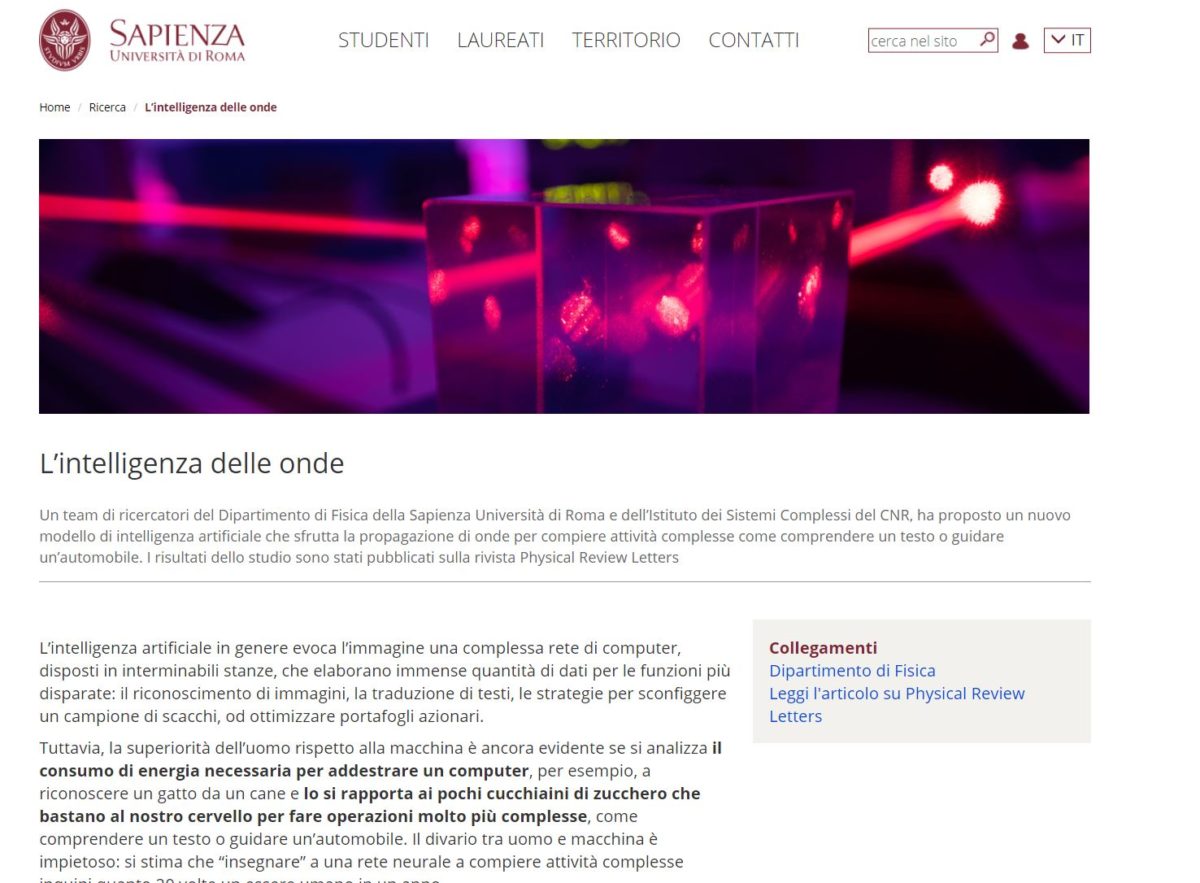
Press release on the AI of waves

https://www.uniroma1.it/it/notizia/lintelligenza-delle-onde-1

https://www.cnr.it/en/press-release/9652/l-intelligenza-delle-onde

https://www.phys.uniroma1.it/fisica/archivionotizie/theory-neuromorphic-computing-waves

https://www.virgilio.it/italia/enna/notizielocali/l_intelligenza_delle_onde-63443731.html

https://www.virgilio.it/italia/enna/notizielocali/l_intelligenza_delle_onde-63443731.html

https://it.finance.yahoo.com/notizie/da-cnr-modello-intelligenza-artificiale-che-sfrutta-onde-124603891.html

https://www.e-gazette.it/sezione/tecnologia/incredibol-sapienza-cnr-studiano-intelligenza-onde

https://electomagazine.it/lintelligenza-delle-onde-e-il-risparmio-energetico/
Electomagazine.it

https://ilcorrieredelweb.blogspot.com/2020/09/scienza-cnr-lintelligenza-delle-onde.html

https://www.lescienze.it/news/2020/09/22/news/l_intelligenza_delle_onde-4800586/

https://it.notizie.yahoo.com/da-cnr-modello-intelligenza-artificiale-che-sfrutta-onde-124603891.html

Nuove Direzioni numero 62, Nov-Dic 2020, pag. 75 “L’intelligenza delle onde”

Messaggero, 5 October 2020

Interview of Claudio Conti (podcast)

https://rbe.it/2020/10/22/allenare-le-intelligenze-artificiali-con-le-onde/