https://link.springer.com/book/10.1007/978-3-031-44226-1
Related activities
Read many books for many years

About coding in any language
Classical or quantum physical systems can simulate the Ising Hamiltonian for large-scale optimization and machine learning. However, devices such as quantum annealers and coherent Ising machines suffer an exponential drop in the probability of success in finite-size scaling. We show that by exploiting high dimensional embedding of the Ising Hamiltonian and subsequent dimensional annealing, the drop is counteracted by an exponential improvement in the performance. Our analysis relies on extensive statistics of the convergence dynamics by high-performance computing. We propose a realistic experimental implementation of the new annealing device by off-the-shelf coherent Ising machine technology. The hyperscaling heuristics can also be applied to other quantum or classical Ising machines by engineering nonlinear gain, loss, and non-local couplings.
Hyperscaling in the coherent hyperspin machine
https://arxiv.org/abs/2308.02329

Highly accurate biosensors for few or single molecule detection play a central role in numerous key fields, such as healthcare and environmental monitoring. In the last decade, laser biosensors have been investigated as proofs of concept, and several technologies have been proposed. We here propose a demonstration of polymeric whispering gallery microlasers as biosensors for detecting small amounts of proteins down to 400 pg. They have the advantage of working in free space without any need for waveguiding for input excitation or output signal detection. The photonic microsensors can be easily patterned on microscope slides and operate in air and solution. We estimate the limit of detection up to 148 nm/RIU for three different protein dispersions. In addition, the sensing ability of passive spherical resonators in the presence of dielectric nanoparticles that mimic proteins is described by massive ab initio numerical simulations.
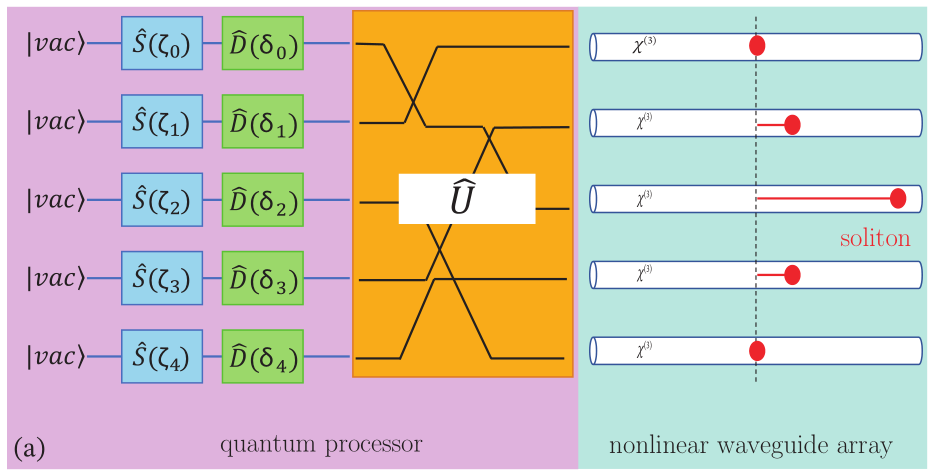
In the context of quantum information, highly nonlinear regimes, such as those supporting solitons, are marginally investigated. We miss general methods for quantum solitons, although they can act as entanglement generators or as self-organized quantum processors. We develop a computational approach that uses a neural network as a variational ansatz for quantum solitons in an array of waveguides. By training the resulting phase-space quantum machine learning model, we find different soliton solutions varying the number of particles and interaction strength. We consider Gaussian states that enable measuring the degree of entanglement and sampling the probability distribution of many-particle events. We also determine the probability of generating particle pairs and unveil that soliton bound states emit correlated pairs. These results may have a role in boson sampling with nonlinear systems and in quantum processors for entangled nonlinear waves