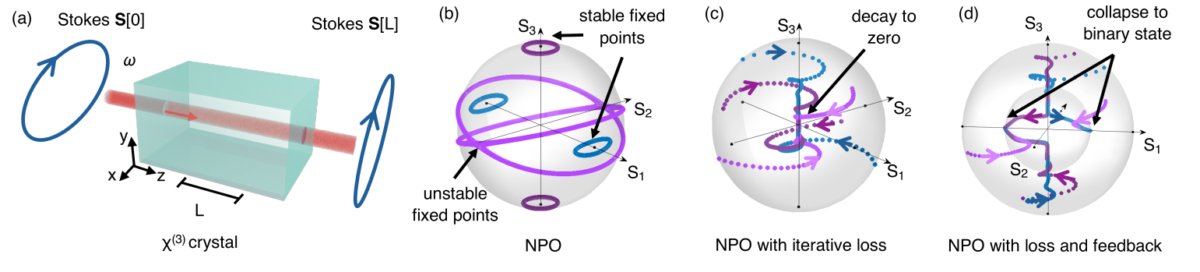
Ising Machine by Dimensional Collapse of Nonlinear Polarization Oscillators

https://journals.aps.org/prl/abstract/10.1103/qs29-2xqc

Phys. Rev. Lett. 135, 063801 – Published 4 August, 2025

Ising machines show promise as ultrafast hardware for optimizations encoded in Ising Hamiltonians but fall short in terms of success rate and performance scaling. Here, we propose a novel Ising machine that exploits the three-dimensional nature of nonlinear polarization oscillators to counteract these limitations. Based on the evolution of the optical polarization in third-order nonlinear media, the high-dimensional machine reaches the Ising ground state by the mechanism of “dimensional collapse”: the dynamics on the Poincaré sphere undergoes a self-induced collapse into polarization fixed points mapping an Ising spin. Collapse from a spherical to a binary spin occurs when the polarization oscillator experiences iterative loss and anisotropic feedback. The photonic setup consists of polarization modulated pulses in a 𝜒(3) crystal subject to measurement and feedback. We numerically demonstrate the polarization machine achieves enhanced success probability on benchmark graphs and an exponential improvement in performance scaling with respect to coherent Ising machines due to its high-dimensional operation. The proposed Ising machine paves the way for a new class of Ising solvers with enhanced computing capabilities.

The solution to energy demanding artificial intelligence : optical neural networks with solar cells

https://www.researching.cn/articles/OJ930a39ae0105db58

https://opg.optica.org/prj/abstract.cfm?doi=10.1364/PRJ.542564

Optical neural networks (ONNs) are a class of emerging computing platforms that leverage the properties of light to perform ultra-fast computations with ultra-low energy consumption. ONNs often use CCD cameras as the output layer. In this work, we propose the use of perovskite solar cells as a promising alternative to imaging cameras in ONN designs. Solar cells are ubiquitous, versatile, highly customizable, and can be fabricated quickly in laboratories. Their large acquisition area and outstanding efficiency enable them to generate output signals with a large dynamic range without the need for amplification. Here we have experimentally demonstrated the feasibility of using perovskite solar cells for capturing ONN output states, as well as the capability of single-layer random ONNs to achieve excellent performance even with a very limited number of pixels. Our results show that the solar-cell-based ONN setup consistently outperforms the same setup with CCD cameras of the same resolution. These findings highlight the potential of solar-cell-based ONNs as an ideal choice for automated and battery-free edge-computing applications.

https://doi.org/10.1364/PRJ.542564

Emergent Equilibrium in All-Optical Single Quantum-Trajectory Ising Machines

We investigate the dynamics of multi-mode optical systems driven by two-photon processes and subject to non-local losses, incorporating quantum noise at the Gaussian level. Our findings show that the statistics from a single Gaussian quantum trajectory exhibit emergent thermal equilibrium governed by an Ising Hamiltonian encoded in the dissipative coupling between modes. The driving strength sets the system’s effective temperature relative to the oscillation threshold. Given the ultra-short time scales typical of all-optical devices, our study demonstrates that such multi-mode optical systems can operate as ultra-fast Boltzmann samplers, paving the way toward the realization of efficient hardware for combinatorial optimization, with promising applications in machine learning and beyond.

https://arxiv.org/abs/2412.12768

https://mathstodon.xyz/@nonlinearxwaves/113672283856089363

Fully Programmable Spatial Photonic Ising Machine by Focal Plane Division

https://arxiv.org/abs/2410.10689

Ising machines are an emerging class of hardware that promises ultrafast and energy-efficient solutions to NP-hard combinatorial optimization problems. Spatial photonic Ising machines (SPIMs) exploit optical computing in free space to accelerate the computation, showcasing parallelism, scalability, and low power consumption. However, current SPIMs can implement only a restricted class of problems. This partial programmability is a critical limitation that hampers their benchmark. Achieving full programmability of the device while preserving its scalability is an open challenge. Here, we report a fully programmable SPIM achieved through a novel operation method based on the division of the focal plane. In our scheme, a general Ising problem is decomposed into a set of Mattis Hamiltonians, whose energies are simultaneously computed optically by measuring the intensity on different regions of the camera sensor. Exploiting this concept, we experimentally demonstrate the computation with high success probability of ground-state solutions of up to 32-spin Ising models on unweighted maximum cut graphs with and without ferromagnetic bias. Simulations of the hardware prove a favorable scaling of the accuracy with the number of spins. Our fully programmable SPIM enables the implementation of many quadratic unconstrained binary optimization problems, further establishing SPIMs as a leading paradigm in non von Neumann hardware.

https://mathstodon.xyz/@nonlinearxwaves/113310235718756468