And among the most downloaded papers …

Read many books for many years

And among the most downloaded papers …
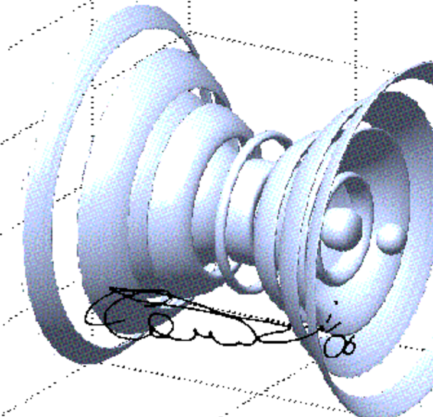
In any form of wave propagation, strong spatiotemporal coupling appears when non-elementary, three-dimensional wave-packets are composed by superimposing pure plane waves, or spontaneously generated by light-matter interaction and nonlinear processes. Ultrashort pulses with orbital angular momentum (OAM), or ultrashort vortices, furnish a critical paradigm in which the analysis of the spatiotemporal coupling in the form of temporal-OAM coupling can be carried out accurately by analytical tools. By generalizing and unifying previously reported results, we show that universal and spatially heterogeneous space-time correlations occur in propagation-invariant temporal pulses carrying OAM. In regions with high intensity, the pulse duration has a lower bound fixed by the topological charge of the vortex and such that the duration must increase with the topological charge. In regions with low intensity in the vicinity of the vortex, a large blue-shift of the carrier oscillations and an increase of the number of them is predicted for strongly twisted beams. We think that these very general findings highlight the existence of a structural coupling between space and time, which is relevant at low photon numbers in quantum optics, and also in the highly nonlinear process as the high-harmonics generated with twisted beams. These results have also applications as multi-level classical and quantum free-space or satellite, communications, spectroscopy, and high-harmonic generation.
Miguel A. Porras and C. Conti in arXiv:1911.1222
From optics to hydrodynamics, shock and rogue waves are widespread. Although they appear as distinct phenomena, transitions between extreme waves are allowed. However, these have never been experimentally observed because control strategies are still missing. We introduce the new concept of topological control based on the one-to-one correspondence between the number of wave packet oscillating phases and the genus of toroidal surfaces associated with the nonlinear Schrödinger equation solutions through Riemann theta functions. We demonstrate the concept experimentally by reporting observations of supervised transitions between waves with different genera. Considering the box problem in a focusing photorefractive medium, we tailor the time-dependent nonlinearity and dispersion to explore each region in the state diagram of the nonlinear wave propagation. Our result is the first realization of topological control of nonlinear waves. This new technique casts light on shock and rogue waves generation and can be extended to other nonlinear phenomena.
Nature Communications volume 10, Article number: 5090 (2019)
Dispersive shock waves are fascinating phenomena occurring when nonlinearity overwhelms linear effects, such as dispersion and diffraction. Many features of shock waves are still under investigation, as the interplay with noninstantaneity in temporal pulses transmission and nonlocality in spatial beams propagation. Despite the rich and vast literature on nonlinear waves in optical Kerr media, spatial dispersive shock waves in nonlocal materials deserve further attention for their unconventional properties. Indeed, they have been investigated in colloidal matter, chemical physics and biophotonics, for sensing and control of extreme phenomena. Here we review the last developed theoretical models and recent optical experiments on spatial dispersive shock waves in nonlocal media. Moreover, we discuss observations in novel versatile materials relevant for soft matter and biology.