Observation of 2D dam break flow and a gaseous phase of solitons in a photon fluid in PRL

We report the observation of a two-dimensional dam break flow of a photon fluid in a nonlinear optical crystal. By precisely shaping the amplitude and phase of the input wave, we investigate the transition from one-dimensional (1D) to two-dimensional (2D) nonlinear dynamics. We observe wave breaking in both transverse spatial dimensions with characteristic timescales determined by the aspect ratio of the input box-shaped field. The interaction of dispersive shock waves propagating in orthogonal directions gives rise to a 2D ensemble of solitons. Depending on the box size, we report the evidence of a dynamic phase characterized by a constant number of solitons, resembling a 1D solitons gas in integrable systems. We measure the statistical features of this gaseous-like phase. Our findings pave the way to the investigation of collective solitonic phenomena in two dimensions, demonstrating that the loss of integrability does not disrupt the dominant phenomenology.

https://arxiv.org/abs/2409.18738

https://mathstodon.xyz/@nonlinearxwaves/113258813170717367

https://journals.aps.org/prl/abstract/10.1103/PhysRevLett.133.183801

Deep Learning Enabled Transmission of Full-Stokes Polarization Images Through Complex Media

Polarization images offer crucial functionalities across multiple scientific domains, providing access to physical information beyond conventional measures such as intensity, phase, and spectrum of light. However, the challenge of transmitting polarization images through complex media has restricted their application in optical communication and imaging. Here, a novel approach utilizing deep learning for the transmission of full-Stokes polarization images through scattering media is presented. It is demonstrated that any input polarization image can be reconstructed in a single shot by employing only an intensity sensor. By supervised training of a deep neural network, high-accuracy full-Stokes reconstruction is achieved from the speckle pattern detected by an intensity camera. Leveraging the deep learning based polarization decoder, a polarization-colored encoding scheme is devised to enable increased-capacity data transmission through disordered channels. Fast, wavelength-independent, on-chip, polarization imaging in complex media enables the utilization of polarization-structured light in multimode fibres and opaque materials, unlocking new possibilities in optical communication, cryptography, and quantum technology.

https://doi.org/10.1002/lpor.202400626

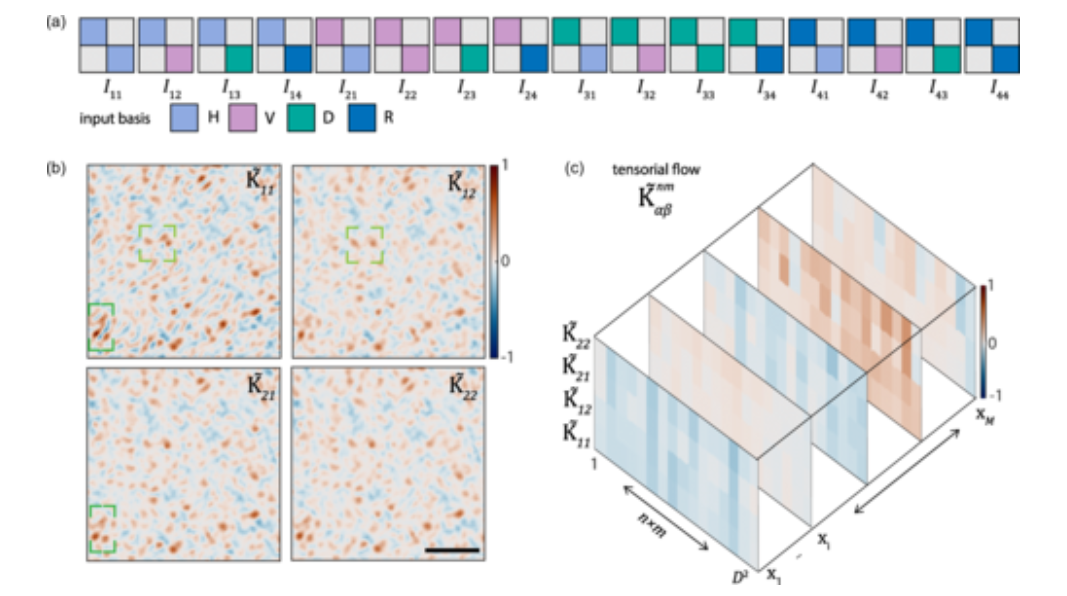
Tensorial flow of mosaic beams in PRL !

https://journals.aps.org/prl/abstract/10.1103/PhysRevLett.132.243801

Optical beams with nonuniform polarization offer enhanced capabilities for information transmission, boasting increased capacity, security, and resilience. These beams possess vectorial features that are spatially organized within localized three-dimensional regions, forming tensors that can be harnessed across a spectrum of applications spanning quantum physics, imaging, and machine learning. However, when subjected to the effect of the transmission channel, the tensorial propagation leads to a loss of data integrity due to the entanglement of spatial and polarization degrees of freedom. The challenge of quantifying this spatial-polarization coupling poses a significant obstacle to the utilization of vector beams in turbulent environments, multimode fibers, and disordered media. Here, we introduce and experimentally investigate mosaic vector beams, which consist of localized polarization tesserae that propagate in parallel, demonstrating accurate measurement of their behavior as they traverse strongly disordered channels and decoding their polarization structure in single-shot experiments. The resultant transmission tensor empowers polarization-based optical communication and imaging in complex media. These findings also hold promise for photonic machine learning, where the engineering of tensorial flow can enable optical computing with high throughput.

EIC Project HEISINGBERG launched !

The EU project HEISINGBERG has started!

This project is funded by the EIC-Pathfinder initiative of the European Innovation Council for innovative Quantum technologies.

The project leverages our Spatial Ising Machine (SPIM) device and aims at a new generation of programmable and quantum annealers.

For details, have a look at the HEISINGBERG website.

HEISINGBERG logo and website

See also