Ising Machine by Dimensional Collapse of Nonlinear Polarization Oscillators

https://journals.aps.org/prl/abstract/10.1103/qs29-2xqc

Phys. Rev. Lett. 135, 063801 – Published 4 August, 2025

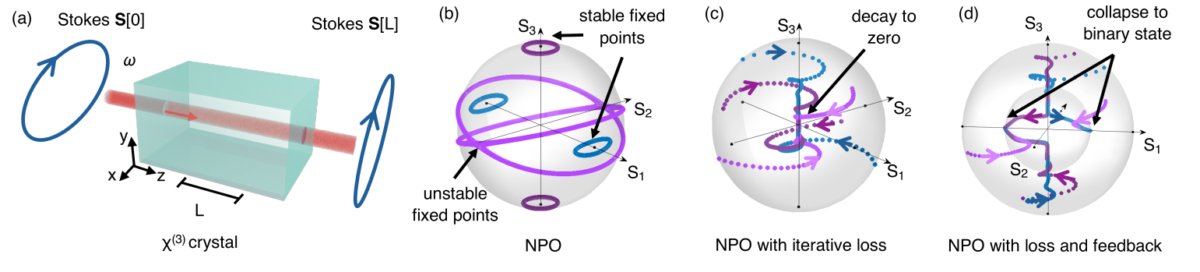
Ising machines show promise as ultrafast hardware for optimizations encoded in Ising Hamiltonians but fall short in terms of success rate and performance scaling. Here, we propose a novel Ising machine that exploits the three-dimensional nature of nonlinear polarization oscillators to counteract these limitations. Based on the evolution of the optical polarization in third-order nonlinear media, the high-dimensional machine reaches the Ising ground state by the mechanism of “dimensional collapse”: the dynamics on the Poincaré sphere undergoes a self-induced collapse into polarization fixed points mapping an Ising spin. Collapse from a spherical to a binary spin occurs when the polarization oscillator experiences iterative loss and anisotropic feedback. The photonic setup consists of polarization modulated pulses in a 𝜒(3) crystal subject to measurement and feedback. We numerically demonstrate the polarization machine achieves enhanced success probability on benchmark graphs and an exponential improvement in performance scaling with respect to coherent Ising machines due to its high-dimensional operation. The proposed Ising machine paves the way for a new class of Ising solvers with enhanced computing capabilities.
Equalized Hyperspin Machine

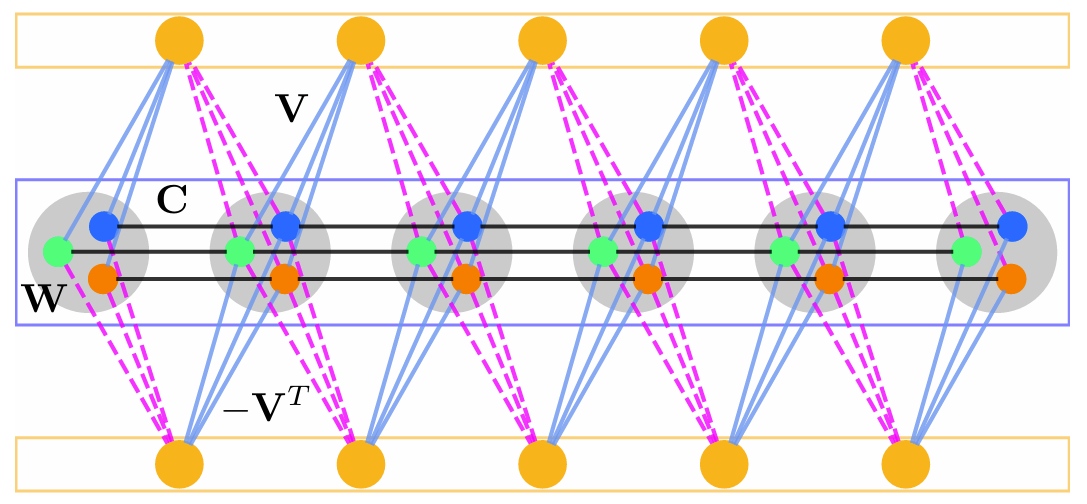
The reliable simulation of spin models is of critical importance to tackle complex optimization problems that are intractable on conventional computing machines. The recently introduced hyperspin machine, which is a network of linearly and nonlinearly coupled parametric oscillators, provides a versatile simulator of general classical vector spin models in arbitrary dimension, finding the minimum of the simulated spin Hamiltonian and implementing novel annealing algorithms. In the hyperspin machine, oscillators evolve in time minimizing a cost function that must resemble the desired spin Hamiltonian in order for the system to reliably simulate the target spin model. This condition is met if the hyperspin amplitudes are equal in the steady state. Currently, no mechanism to enforce equal amplitudes exists. Here, we bridge this gap and introduce a method to simulate the hyperspin machine with equalized amplitudes in the steady state. We employ an additional network of oscillators (named equalizers) that connect to the hyperspin machine via an antisymmetric nonlinear coupling and equalize the hyperspin amplitudes. We demonstrate the performance of such an equalized hyperspin machine by large-scale numerical simulations up to 10000 hyperspins. Compared to the hyperspin machine without equalization, we find that the equalized hyperspin machine (i) Reaches orders of magnitude lower spin energy, and (ii) Its performance is significantly less sensitive to the system parameters. The equalized hyperspin machine offers a competitive spin Hamiltonian minimizer and opens the possibility to combine amplitude equalization with complex annealing protocols to further boost the performance of spin machines.

[2507.12940] Equalized Hyperspin Machine

Phys. Rev. A 112, 053505 (2025)

Emergent Equilibrium in All-Optical Single Quantum-Trajectory Ising Machines

We investigate the dynamics of multi-mode optical systems driven by two-photon processes and subject to non-local losses, incorporating quantum noise at the Gaussian level. Our findings show that the statistics from a single Gaussian quantum trajectory exhibit emergent thermal equilibrium governed by an Ising Hamiltonian encoded in the dissipative coupling between modes. The driving strength sets the system’s effective temperature relative to the oscillation threshold. Given the ultra-short time scales typical of all-optical devices, our study demonstrates that such multi-mode optical systems can operate as ultra-fast Boltzmann samplers, paving the way toward the realization of efficient hardware for combinatorial optimization, with promising applications in machine learning and beyond.

https://arxiv.org/abs/2412.12768

https://mathstodon.xyz/@nonlinearxwaves/113672283856089363

Quantum Hyperspins: A New Schroedinger’s Cat ?

https://arxiv.org/abs/2411.05728

We report on the emergence of a highly non-classical collective behavior in quantum parametric oscillators, which we name quantum hyperspin, induced by a tailored nonlinear interaction. This is the second quantized version of classical multidimensional spherical spins, as XY spins in two dimensions and Heisenberg spins in three dimensions. In the phase space, the quantum hyperspins are represented as spherical shells whose radius scales with the number of particles in a way such that it cannot be factorized even in the limit of large particle number. We show that the nonlinearly coupled quantum oscillators form a high-dimensional entangled state that is surprisingly robust with respect to the coupling with the environment. Such a behavior results from a properly engineered reservoir. Networks of entangled quantum hyperspins are a new approach to quantum simulations for applications in computing, Ising machines, and high-energy physics models. From first principles through ab initio numerical simulations, we analyze the properties of quantum hyperspins, including the interplay of entanglement and coupling frustration.

Quantum hyperspins: Highly nonclassical collective behavior in quantum optical parametric oscillators

https://journals.aps.org/pra/abstract/10.1103/PhysRevA.111.043712

https://mathstodon.xyz/@nonlinearxwaves/113462588899837887