Super-Duper Ising Machine by a Single SLM

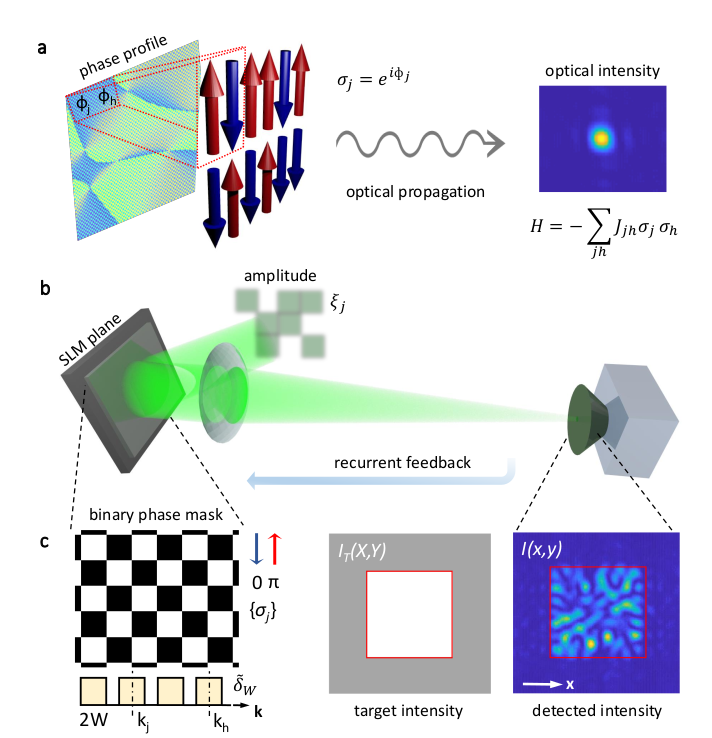
Quantum and classical physics can be used for mathematical computations that are hard to tackle by conventional electronics. Very recently, optical Ising machines have been demonstrated for computing the minima of spin Hamiltonians, paving the way to new ultra-fast hardware for machine learning. However, the proposed systems are either tricky to scale or involve a limited number of spins. We design and experimentally demonstrate a large-scale optical Ising machine based on a simple setup with a spatial light modulator. By encoding the spin variables in a binary phase modulation of the field, we show that light propagation can be tailored to minimize an Ising Hamiltonian with spin couplings set by input amplitude modulation and a feedback scheme. We realize configurations with thousands of spins that settle in the ground state in a low-temperature ferromagnetic-like phase with all-to-all and tunable pairwise interactions. Our results open the route to classical and quantum photonic Ising machines that exploit light spatial degrees of freedom for parallel processing of a vast number of spins with programmable couplings.

D. Pierangeli, G. Marcucci, C. Conti in ArXiv:1905.11548 and Phys. Rev. Lett. 122, 213902 (2019)

See also

PhoQus project launched!

Our project within the Quantum Technologies Flagship has been launched. The topic is quantum simulations of fundamental physical processes, as Bose-Einstein condensation of photons and gravitational physics!

The project involves Sorbonne University, CNRS, Sapienza, UBO, IST, Imperial, CNR and UPDiderot

FET Quantum Technologies Flagship Grant Number 820392

Quantum-gravity-slingshot: orbital precession due to the modified uncertainty principle, from analogs to tests of Planckian physics with quantum fluids

Modified uncertainty principle and non-commutative variables may phenomenologically account for quantum gravity effects, independently of the considered theory of quantum gravity. We show that quantum fluids enable experimental analogs and direct tests of the modified uncertainty principle expected to be valid at the Planck scale. We consider a quantum clock realized by a long-lasting quantum fluid wave-packet orbiting in a trapping potential. We investigate the hydrodynamics of the Schr\”odinger equation encompassing kinetic terms due to Planck-scale effects. We study the resulting generalized mechanics and validate the predictions by quantum simulations. Wave-packet orbiting generates a continuous amplification of the quantum gravity effects. The non-commutative variables in the phase-space produce a precession and an acceleration of the orbital motion. The precession of the orbit is strongly resembling the famous orbital precession of the perihelion of Mercury used by Einstein to validate the corrections of general relativity to Newton’s theory. In our case, the corrections are due to the modified uncertainty principle. The results can be employed to emulate quantum gravity in the laboratory, or to realize human-scale experiments to determine bounds for the most studied quantum-gravity models and probe Planckian physics.

Giulia Marcucci and Claudio Conti, arXiv:1805.03600