Electric directional steering of cathodoluminescence from graphene-based hydrid nanostructures

Controlling directional emission of nanophotonic radiation sources is fundamental to tailor radiation-matter interaction and to conceive highly efficient nanophotonic devices for on-chip wireless communication and information processing. Nanoantennas coupled to quantum emitters have proven to be very efficient radiation routers, while electrical control of unidirectional emission has been achieved through inelastic tunneling of electrons. Here we prove that the radiation emitted from the interaction of a high-energy electron beam with a graphene-nanoparticle composite has beaming directions which can be made to continuously span the full circle even through small variations of the graphene Fermi energy. Emission directionality stems from the interference between the double cone shaped electron transition radiation and the nanoparticle dipolar diffraction radiation. Tunability is enabled since the interference is ruled by the nanoparticle dipole moment whose amplitude and phase are driven by the hybrid plasmonic resonances of the composite and the absolute phase of the graphene plasmonic polariton launched by the electron, respectively. The flexibility of our method provides a way to exploit graphene plasmon physics to conceive improved nanosources with ultrafast reconfigurable radiation patterns.

Ciattoni, Conti, Marini in https://arxiv.org/abs/2010.09017

Press release on the AI of waves

https://www.uniroma1.it/it/notizia/lintelligenza-delle-onde-1

https://www.cnr.it/en/press-release/9652/l-intelligenza-delle-onde

https://www.phys.uniroma1.it/fisica/archivionotizie/theory-neuromorphic-computing-waves

https://www.virgilio.it/italia/enna/notizielocali/l_intelligenza_delle_onde-63443731.html

https://www.virgilio.it/italia/enna/notizielocali/l_intelligenza_delle_onde-63443731.html

https://it.finance.yahoo.com/notizie/da-cnr-modello-intelligenza-artificiale-che-sfrutta-onde-124603891.html

https://www.e-gazette.it/sezione/tecnologia/incredibol-sapienza-cnr-studiano-intelligenza-onde

https://electomagazine.it/lintelligenza-delle-onde-e-il-risparmio-energetico/
Electomagazine.it

https://ilcorrieredelweb.blogspot.com/2020/09/scienza-cnr-lintelligenza-delle-onde.html

https://www.lescienze.it/news/2020/09/22/news/l_intelligenza_delle_onde-4800586/

https://it.notizie.yahoo.com/da-cnr-modello-intelligenza-artificiale-che-sfrutta-onde-124603891.html

Nuove Direzioni numero 62, Nov-Dic 2020, pag. 75 “L’intelligenza delle onde”

Messaggero, 5 October 2020

Interview of Claudio Conti (podcast)

https://rbe.it/2020/10/22/allenare-le-intelligenze-artificiali-con-le-onde/

Living Random Optical Neural Network

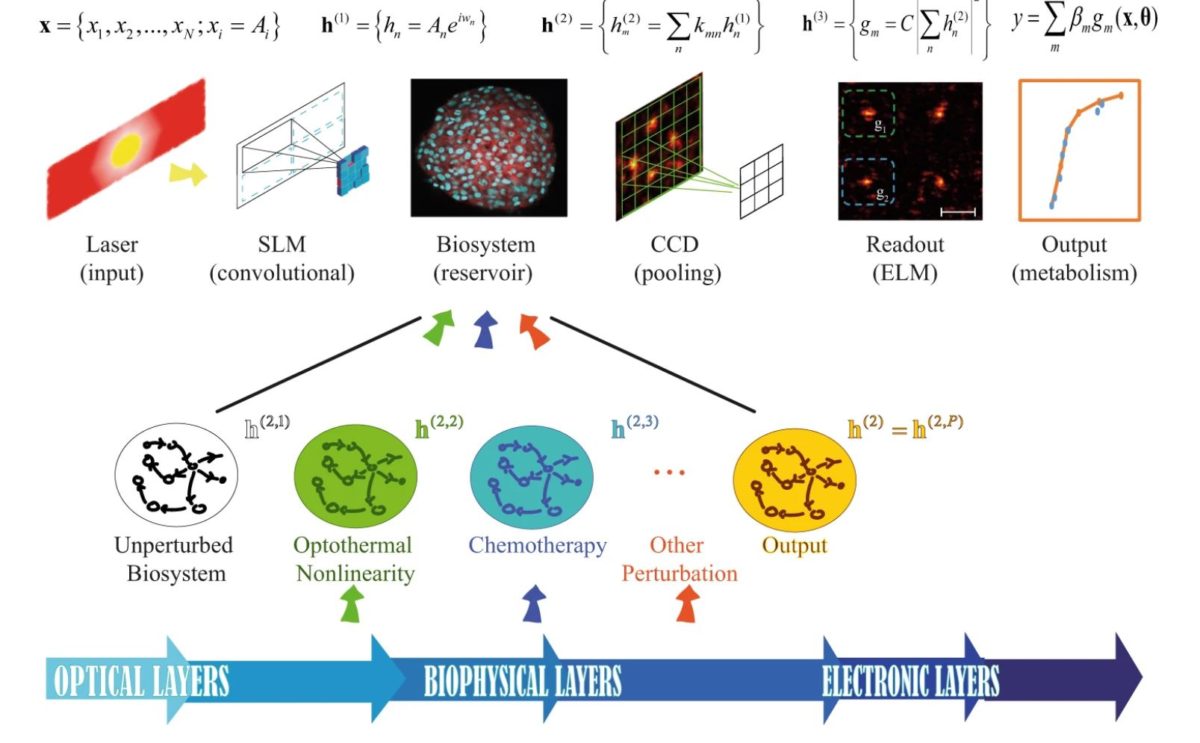
Optical neural networks process information at the speed of light and are energetically efficient. Photonic artificial intelligence allows speech recognition, image classification, and Ising machines. Modern machine learning paradigms, as extreme learning machines, reveal that disordered and biological materials may realize optical neural networks with thousands of nodes trained only at the input and at the readout. May we use living matter for machine learning? Here, we employ living three-dimensional tumor brain models to demonstrate a random optical learning machine (ROM) for the investigation of glioblastoma. The tumor spheroid act as a computational reservoir. The ROM detects cancer morphodynamics by laser-induced hyperthermia, quantifies chemotherapy, and cell metabolism. The ROM is a sensitive noninvasive smart probe for cytotoxicity assay and enables real-time investigation of tumor dynamics. We hence design and demonstrate a novel bio-hardware for optical computing and the study of light/complex matter interaction.

Selected as Editor’s Highlights – Communications Physics 2020

https://www.nature.com/articles/s42005-020-00428-9

Living optical random neural network with three dimensional tumor spheroids for cancer morphodynamics in Communications Physics

See also

ANSA press release