Evidence of Chaotic Dynamics in Three-Soliton Collisions
Read many books for many years


Corriere della Sera 23 agosto 2021
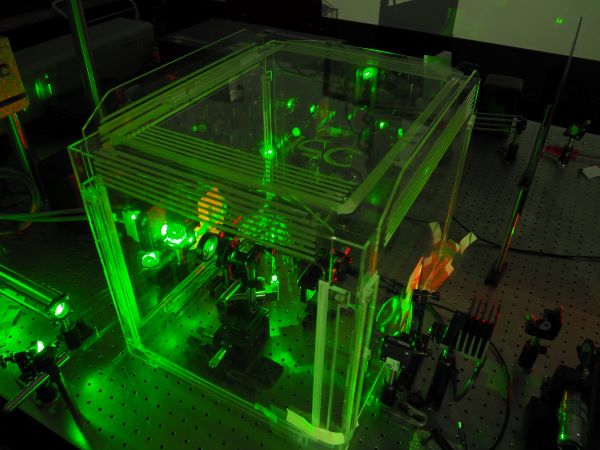
Photonic brain-inspired platforms are emerging as novel analog computing devices, enabling fast and energy-efficient operations for machine learning. These artificial neural networks generally require tailored optical elements, such as integrated photonic circuits, engineered diffractive layers, nanophotonic materials, or time-delay schemes, which are challenging to train or stabilize. Here we present a neuromorphic photonic scheme – photonic extreme learning machines – that can be implemented simply by using an optical encoder and coherent wave propagation in free space. We realize the concept through spatial light modulation of a laser beam, with the far field that acts as feature mapping space. We experimentally demonstrated learning from data on various classification and regression tasks, achieving accuracies comparable to digital extreme learning machines. Our findings point out an optical machine learning device that is easy-to-train, energetically efficient, scalable and fabrication-constraint free. The scheme can be generalized to a plethora of photonic systems, opening the route to real-time neuromorphic processing of optical data.
Combinatorial optimization problems are crucial for widespread applications but remain difficult to solve on a large scale with conventional hardware. Novel optical platforms, known as coherent or photonic Ising machines, are attracting considerable attention as accelerators on optimization tasks formulable as Ising models. Annealing is a well-known technique based on adiabatic evolution for finding optimal solutions in classical and quantum systems made by atoms, electrons, or photons. Although various Ising machines employ annealing in some form, adiabatic computing on optical settings has been only partially investigated. Here, we realize the adiabatic evolution of frustrated Ising models with 100 spins programmed by spatial light modulation. We use holographic and optical control to change the spin couplings adiabatically, and exploit experimental noise to explore the energy landscape. Annealing enhances the convergence to the Ising ground state and allows to find the problem solution with probability close to unity. Our results demonstrate a photonic scheme for combinatorial optimization in analogy with adiabatic quantum algorithms and classical annealing methods but enforced by optical vector-matrix multiplications and scalable photonic technology.
https://www.osapublishing.org/optica/fulltext.cfm?uri=optica-7-11-1535&id=442147
See also https://arxiv.org/abs/2005.08690