Non-abelian Thouless pumping in a photonic lattice

Non-abelian gauge fields emerge naturally in the description of adiabatically evolving quantum systems having degenerate levels. Here we show that they also play a role in Thouless pumping in the presence of degenerate bands. To this end we consider a photonic Lieb lattice having two degenerate non-dispersive modes and we show that, when the lattice parameters are slowly modulated, the propagation of the photons bear the fingerprints of the underlying non-abelian gauge structure. The non-dispersive character of the bands enables a high degree of control on photon propagation. Our work paves the way to the generation and detection of non-abelian gauge fields in photonic and optical lattices.

Non-abelian gauge fields lie at the very heart of many modern physical theories. We need new experimental routes and observables to disclose the importance of the Wilczek and Zee holonomy. We have shown that properly
designed photonic lattices enable the control of the beam evolution by non-commutative fields. These lattices may lead to the direct observation of the quantization of the displacement due to a non-abelian Chern number. This work can be extended in several directions, including nonlinear effects or considering the propagation of non-classical light in non-abelian lattices. Both these possibilities are unexplored so far and open several new questions concerning – for example – the effect of the non-abelian holonomy on entanglement or the impact of nonlinearity in breaking the hidden symmetries. Non-abelian topological photonics may stimulate further developments and applications for classical and quantum information and tests of fundamental physics.

Brosco, Pilozzi, Fazio, and Conti, in https://arxiv.org/abs/2010.15159
The Artificial Intelligence of Waves

In a paper published in Physical Review Letters, with title

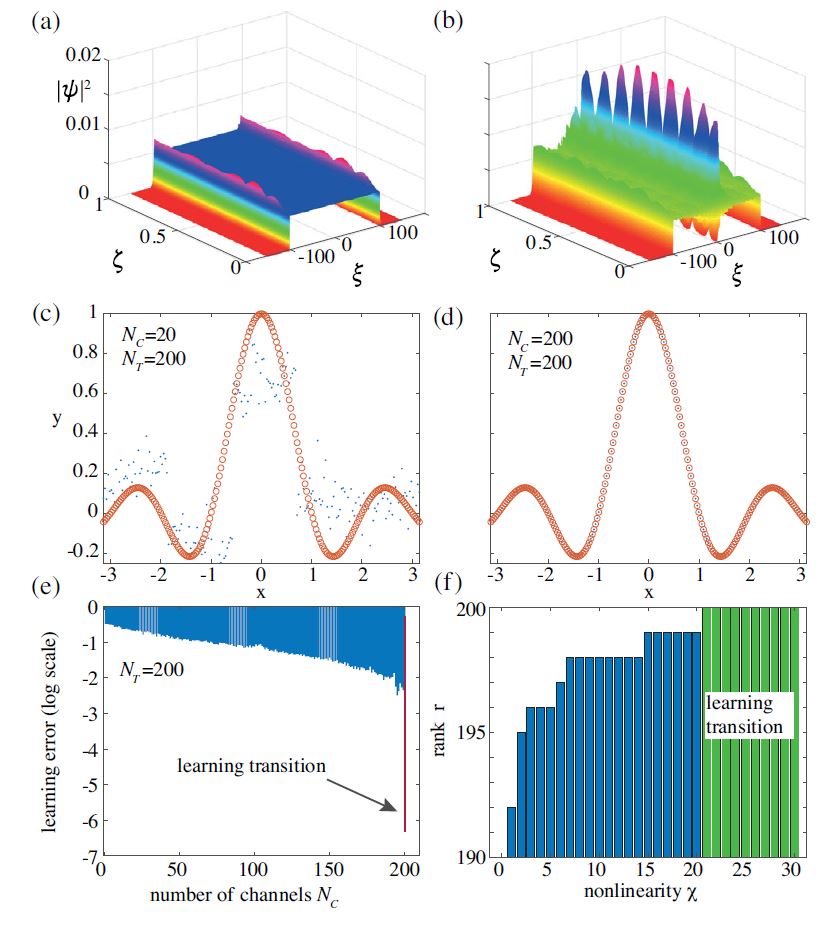
Theory of Neuromorphic Computing by Waves: Machine Learning by Rogue Waves, Dispersive Shocks and Solitons

we study artificial neural networks with nonlinear waves as a computing reservoir. We discuss universality and the conditions to learn a dataset in terms of output channels and nonlinearity. A feed-forward three-layered model, with an encoding input layer, a wave layer, and a decoding readout, behaves as a conventional neural network in approximating mathematical functions, real-world datasets, and universal Boolean gates.
The rank of the transmission matrix has a fundamental role in assessing the learning abilities of the wave.
For a given set of training points, a threshold nonlinearity for universal interpolation exists. When considering the nonlinear Schrödinger equation, the use of highly nonlinear regimes implies that solitons, rogue, and shock waves do have a leading role in training and computing. Our results may enable the realization of novel machine learning devices by using diverse physical systems, as nonlinear optics, hydrodynamics, polaritonics, and Bose-Einstein condensates. The application of these concepts to photonics opens the way to
a large class of accelerators and new computational paradigms. In complex wave systems, as multimodal fibers, integrated optical circuits, random, topological devices, and metasurfaces, nonlinear waves can be employed to perform computation and solve complex combinatorial optimization.

The paper was selected as Editors’Suggestion and Featured in Physics

See also

https://arxiv.org/abs/1912.07044

Programming multi-level quantum gates in disordered computing reservoirs via machine learning

Novel machine learning computational tools open new perspectives for quantum information systems. Here we adopt the open-source programming library TensorFlow to design multi-level quantum gates, including a computing reservoir represented by a random unitary matrix. In optics, the reservoir is a disordered medium or a multi-modal fiber. We show that trainable operators at the input and the readout enable one to realize multi-level gates. We study various qudit gates, including the scaling properties of the algorithms with the size of the reservoir. Despite an initial low slop learning stage, TensorFlow turns out to be an extremely versatile resource for designing gates with complex media, including different models that use spatial light modulators with quantized modulation levels.

Optics Express 28, 14018 (2020)

See also Quantum Gates by Tensorflow

Simulating general relativity and non-commutative geometry by nonparaxial quantum fluids

We show that quantum fluids enable experimental analogs of relativistic orbital precession in the presence of non-paraxial effects. The analysis is performed by the hydrodynamic limit of the Schroedinger equation. The non-commutating variables in the phase-space produce a precession and an acceleration of the orbital motion. The precession of the orbit is formally identical to the famous orbital precession of the perihelion of Mercury used by Einstein to validate the corrections of general relativity to Newton’s theory. In our case, the corrections are due to the modified uncertainty principle. The results may enable novel relativistic analogs in the laboratory, also including sub Planckian phenomenology.

https://iopscience.iop.org/article/10.1088/1367-2630/ab5da8
