

In the context of quantum information, highly nonlinear regimes, such as those supporting solitons, are marginally investigated. We miss general methods for quantum solitons, although they can act as entanglement generators or as self-organized quantum processors. We develop a computational approach that uses a neural network as a variational ansatz for quantum solitons in an array of waveguides. By training the resulting phase-space quantum machine learning model, we find different soliton solutions varying the number of particles and interaction strength. We consider Gaussian states that enable measuring the degree of entanglement and sampling the probability distribution of many-particle events. We also determine the probability of generating particle pairs and unveil that soliton bound states emit correlated pairs. These results may have a role in boson sampling with nonlinear systems and in quantum processors for entangled nonlinear waves
Category: Solitons
The Artificial Intelligence of Waves
In a paper published in Physical Review Letters, with title
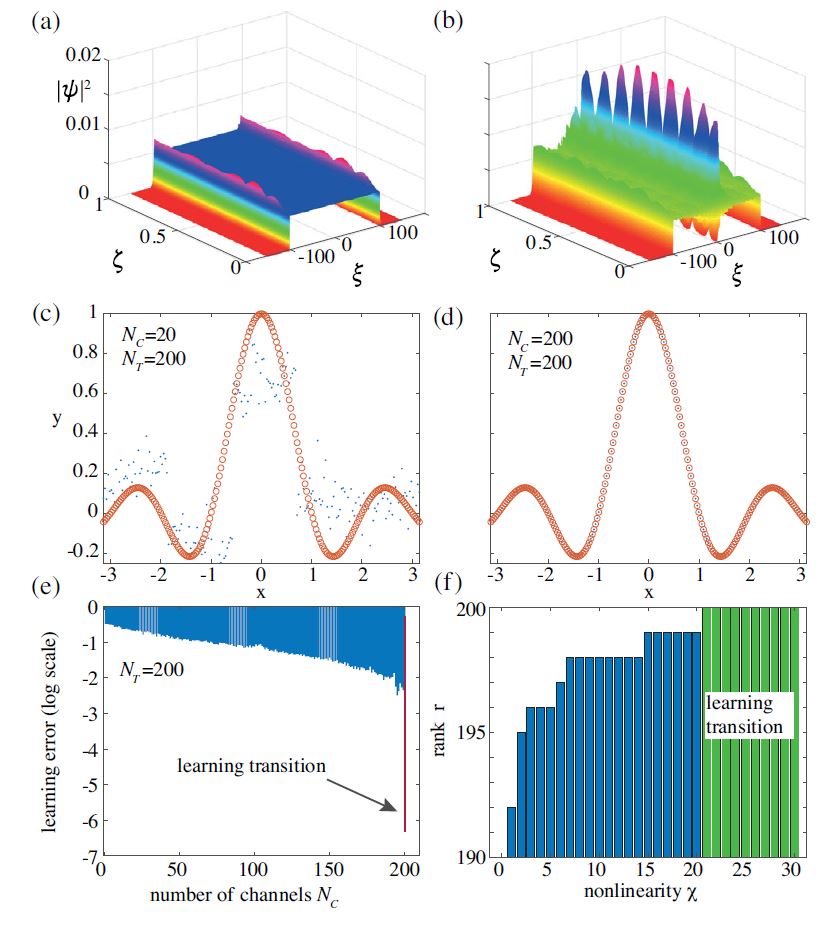
we study artificial neural networks with nonlinear waves as a computing reservoir. We discuss universality and the conditions to learn a dataset in terms of output channels and nonlinearity. A feed-forward three-layered model, with an encoding input layer, a wave layer, and a decoding readout, behaves as a conventional neural network in approximating mathematical functions, real-world datasets, and universal Boolean gates.
The rank of the transmission matrix has a fundamental role in assessing the learning abilities of the wave.
For a given set of training points, a threshold nonlinearity for universal interpolation exists. When considering the nonlinear Schrödinger equation, the use of highly nonlinear regimes implies that solitons, rogue, and shock waves do have a leading role in training and computing. Our results may enable the realization of novel machine learning devices by using diverse physical systems, as nonlinear optics, hydrodynamics, polaritonics, and Bose-Einstein condensates. The application of these concepts to photonics opens the way to
a large class of accelerators and new computational paradigms. In complex wave systems, as multimodal fibers, integrated optical circuits, random, topological devices, and metasurfaces, nonlinear waves can be employed to perform computation and solve complex combinatorial optimization.
The paper was selected as Editors’Suggestion and Featured in Physics
See also
Solitonization of the Anderson localization and rogue waves

In a paper published in Optics Express, M. Saleh, C. Conti, and F. Biancalana, report on a new scenario during rogue wave generation. The random intensity profile of an optical pulse fosters Anderson localization of waves that triggers the generation of solitons (the so-called solitonization) and ultimately rogue events. The process also involves event horizons in analogy with black holes. This is a further evidence of the complexity of supercontinuum generation and extreme events in nonlinear fibre optics.