
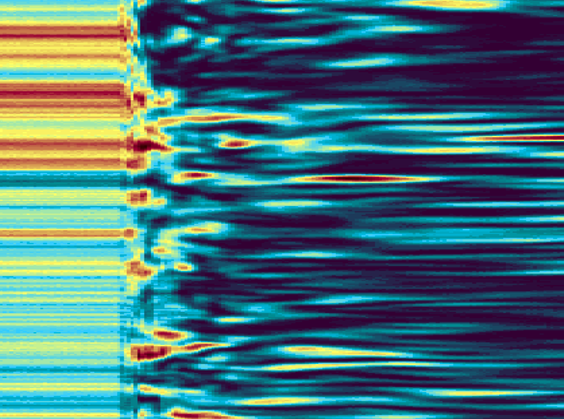
A landmark of statistical mechanics, spin-glass theory describes critical phenomena in disordered systems that range from condensed matter to biophysics and social dynamics. The most fascinating concept is the breaking of replica symmetry: identical copies of the randomly interacting system that manifest completely different dynamics. Replica symmetry breaking has been predicted in nonlinear wave propagation, including Bose-Einstein condensates and optics, but it has never been observed. Here, we report the experimental evidence of replica symmetry breaking in optical wave propagation, a phenomenon that emerges from the interplay of disorder and nonlinearity. When mode interaction dominates light dynamics in a disordered optical waveguide, different experimental realizations are found to have an anomalous overlap intensity distribution that signals a transition to an optical glassy phase. The findings demonstrate that nonlinear propagation can manifest features typical of spin-glasses and provide a novel platform for testing so-far unexplored fundamental physical theories for complex systems.
Lasing on nonlinear localized waves in curved geometry

The use of geometrical constraints exposes many new perspectives in photonics and in fundamental studies of nonlinear waves. By implementing surface structures in vertical cavity surface emitting lasers as manifolds for curved space, we experimentally study the impacts of geometrical constraints on nonlinear wave localization. We observe localized waves pinned to the maximal curvature in an elliptical-ring, and confirm the reduction in the localization length of waves by measuring near and far field patterns, as well as the corresponding energy-angle dispersion relation. Theoretically, analyses based on a dissipative model with a parabola curve give good agreement remarkably to experimental measurement on the reduction in the localization length. The introduction of curved geometry allows to control and design lasing modes in the nonlinear regime.
Kou-Bin Hong, Chun-Yan Lin, Tsu-Chi Chang, Wei-Hsuan Liang, Ying-Yu Lai, Chien-Ming Wu, You-Lin Chuang, Tien-Chang Lu, Claudio Conti, and Ray-Kuang Lee in Optics Express 25, 29068 (2017)
Squeezing of a nonlocal photon fluid
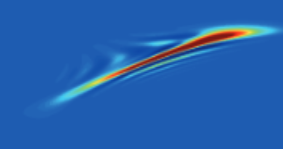
Quantum fluids of light are an emerging tool employed in quantum many-body physics. Their amazing properties and versatility allow using them in a wide variety of fields including gravitation, quantum information, and simulation. However the implications of the quantum nature of light in nonlinear optical propagation are still missing many features. We theoretically predict classical spontaneous squeezing of a photon fluid in a nonlocal nonlinear medium. By using the so called Gamow vectors, we show that the quadratures of a coherent state get squeezed and that a maximal squeezing power exists. Our analysis holds true for temporal and spatial optical propagation in a highly nonlocal regime. These results lead to advances in the quantum photon fluids research and may inspire applications in fields like metrology and analogs of quantum gravity.
M.C.Braidotti, A. Mecozzi, C. Conti, Phys. Rev. A 96, 043823 (2017)
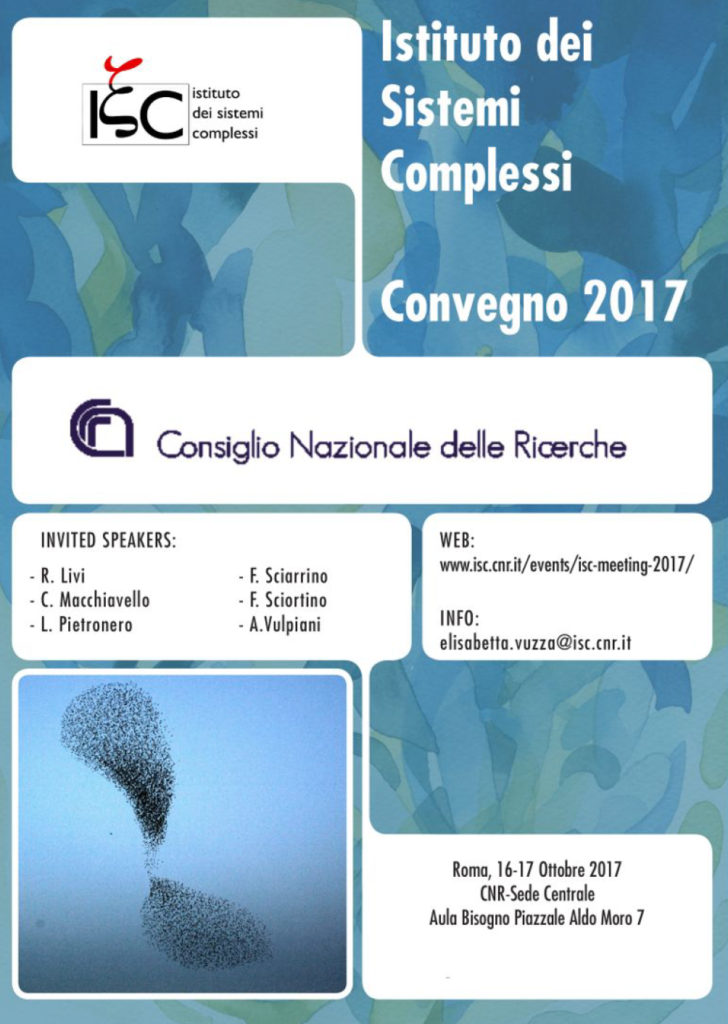
Meeting of the Institute for Complex Systems 2017, october 16-17

OUTNANO out-of-equilibrium nanophotonics

OUTNANO is a Marie Curie Fellowship in the H2020 program funding activity on Out of Equilibrium Nano-photonics
The Marie Curie Fellow is Andrea Marini, a top level young scientist with an extended research career in Nonlinear Photonics.
A new approach for studying novel optical materials in out-of-equilibrium ultrafast dynamics is the goal of this interdisciplinary projects committing together ideas of statical mechanics of complex systems and nonlinear photonics. We will conceive a new generation of nonlinear devices operating at the fastest achievable speeds for classical and quantum applications.
Team of the OUTNANO project