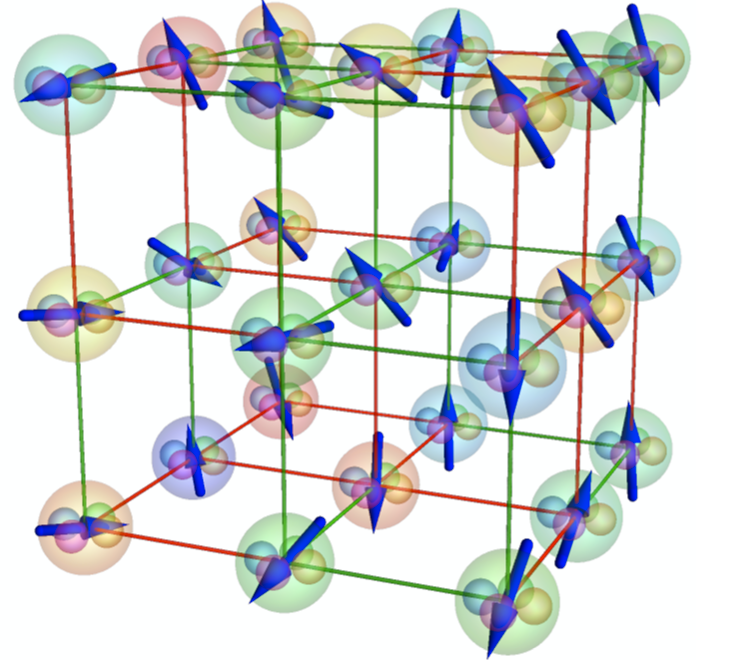
The hyperspin machine: simulating QCD models and dimensional annealing

https://arxiv.org/abs/2203.16190

From condensed matter to quantum chromodynamics, multidimensional spins are a fundamental paradigm, with a pivotal role in combinatorial optimization and machine learning. Machines formed by coupled parametric oscillators can simulate spin models, but only for Ising or low-dimensional spins. Currently, machines implementing arbitrary dimensions remain a challenge. Here, we introduce and validate a hyperspin machine to simulate multidimensional continuous spin models. We realize high-dimensional spins by pumping groups of parametric oscillators, and study NP-hard graphs of hyperspins. The hyperspin machine can interpolate between different dimensions by tuning the coupling topology, a strategy that we call “dimensional annealing”. When interpolating between the XY and the Ising model, the dimensional annealing impressively increases the success probability compared to conventional Ising simulators. Hyperspin machines are a new computational model for combinatorial optimization. They can be realized by off-the-shelf hardware for ultrafast, large-scale applications in classical and quantum computing, condensed-matter physics, and fundamental studies.

Machine Learning Photonics 2022

After the great success of the 2021 edition (online), we are announcing the conference at Lake Como with outstanding lecturers and a wonderful environment!

Official website of the Lake Como School for Advanced Studies

Talks are available on Youtube!

The school has been a successful event, with a lot of new science and enthusiast students! Thanks to all the participants!

3D+1 Quantum Nonlocal Solitons with Gravitational Interaction

https://arxiv.org/abs/2202.10741

Nonlocal quantum fluids emerge as dark-matter models and tools for quantum simulations and technologies. However, strongly nonlinear regimes, like those involving multi-dimensional self-localized solitary waves (nonlocal solitons), are marginally explored for what concerns quantum features. We study the dynamics of 3D+1 solitons in the second-quantized nonlocal nonlinear Schroedinger equation. We theoretically investigate the quantum diffusion of the soliton center of mass and other parameters, varying the interaction length. 3D+1 simulations of the Ito partial differential equations arising from the positive P-representation of the density matrix validate the theoretical analysis. The numerical results unveil the onset of non-Gaussian statistics of the soliton, which may signal quantum-gravitational effects and be a resource for quantum computing. The non-Gaussianity arises from the interplay of the quantum diffusion of the soliton parameters and the stable invariant propagation. The fluctuations and the non-Gaussianity are universal effects expected for any nonlocality and dimensiona