Optimal noise in Ising machines

Ising machines are novel computing devices for the energy minimization of Ising models. These combinatorial optimization problems are of paramount importance for science and technology, but remain difficult to tackle on large scale by conventional electronics. Recently, various photonics-based Ising machines demonstrated ultra-fast computing of Ising ground state by data processing through multiple temporal or spatial optical channels. Experimental noise acts as a detrimental effect in many of these devices. On the contrary, we here demonstrate that an optimal noise level enhances the performance of spatial-photonic Ising machines on frustrated spin problems. By controlling the error rate at the detection, we introduce a noisy-feedback mechanism in an Ising machine based on spatial light modulation. We investigate the device performance on systems with hundreds of individually-addressable spins with all-to-all couplings and we found an increased success probability at a specific noise level. The optimal noise amplitude depends on graph properties and size, thus indicating an additional tunable parameter helpful in exploring complex energy landscapes and in avoiding trapping into local minima. The result points out noise as a resource for optical computing. This concept, which also holds in different nanophotonic neural networks, may be crucial in developing novel hardware with optics-enabled parallel architecture for large-scale optimizations.

arXiv:2004.02208

Published in Nanophotonics

Noise-enhanced spatial-photonic Ising machine

See also

Large scale Ising machine by a spatial light modulator

Theory of neuromorphic computing by waves

Machine-learning by rogue waves, dispersive shocks, and solitons

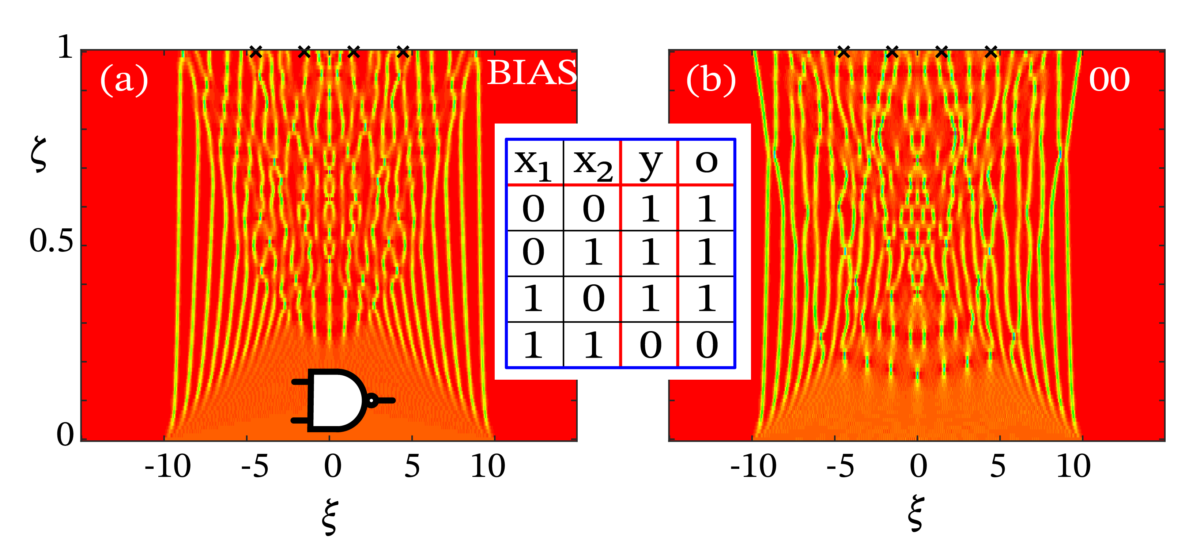
We study artificial neural networks with nonlinear waves as a computing reservoir. We discuss universality and the conditions to learn a dataset in terms of output channels and nonlinearity. A feed-forward three-layer model, with an encoding input layer, a wave layer, and a decoding readout, behaves as a conventional neural network in approximating mathematical functions, real-world datasets, and universal Boolean gates. The rank of the transmission matrix has a fundamental role in assessing the learning abilities of the wave. For a given set of training points, a threshold nonlinearity for universal interpolation exists. When considering the nonlinear Schroedinger equation, the use of highly nonlinear regimes implies that solitons, rogue, and shock waves do have a leading role in training and computing. Our results may enable the realization of novel machine learning devices by using diverse physical systems, as nonlinear optics, hydrodynamics, polaritonics, and Bose-Einstein condensates. The application of these concepts to photonics opens the way to a large class of accelerators and new computational paradigms. In complex wave systems, as multimodal fibers, integrated optical circuits, random, topological devices, and metasurfaces, nonlinear waves can be employed to perform computation and solve complex combinatorial optimization.

ArXiv:1912.07077

PELM Project Kick off, 10 october 2019

PELM PRIN 2017 PROJECT 20177PSCKT

The Kick off meeting of the PELM project will be held on October 10th and 11th starting from 11.00 a.m. in room Aula Garda, Polo Scientifico e Tecnologico, Fabio Ferrari (Povo 1) 

We are happy to announce the event that officially marks the start of the PELM project “Photonic Extreme Learning Machine: from neuromorphic computing to universal optical interpolant, strain gauge sensor and cancer morphodynamic monitor”, programmed on 10th and 11th of October, 2019. PELM aims at demonstrating machine learning photonic devices. Within a single neuromorphic computing architecture, different platforms are specialized to given tasks by their specific characteristics.

In the meeting, the involved team of the University of Trento, Sapienza University of Rome, Scuola Normale Superiore of Pisa, Università Cattolica of Milan and CNR-INO of Neaples, will talk about the project, the objectives and the working methodology to achieve together the desired results. 

For more info please see the agenda