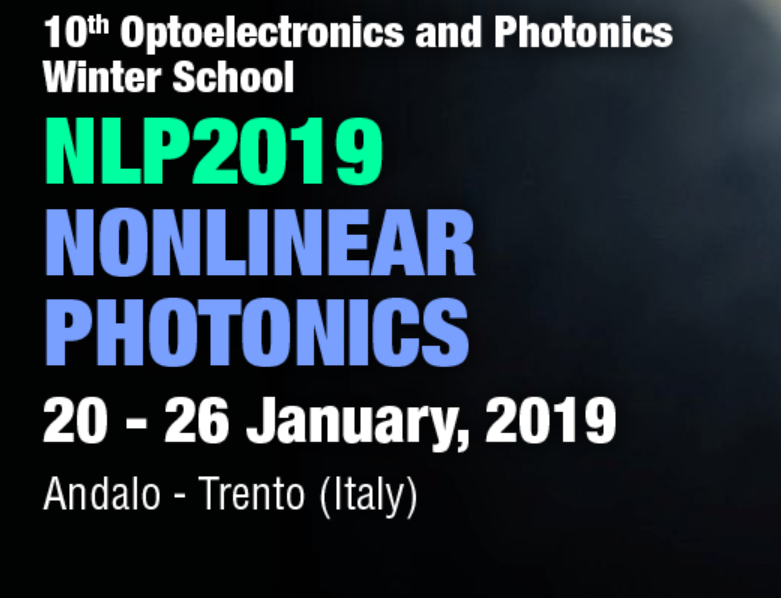
The OSA Nonlinear Optics Topical Meeting (NLO) provides an international forum for discussion of all aspects of nonlinear optics, including new phenomena, novel devices, advanced materials
Details here
Read many books for many years

The OSA Nonlinear Optics Topical Meeting (NLO) provides an international forum for discussion of all aspects of nonlinear optics, including new phenomena, novel devices, advanced materials
Details here
The School aims in bringing together a large number of
Random media with tailored optical properties are attracting burgeoning interest for applications in imaging, biophysics, energy, nanomedicine, spectroscopy, cryptography
A key paradigm for devices based on this class of materials is the transmission matrix, the tensorial link between the input and the output signals, that describes in full their optical behavior. The transmission matrix has specific statistical properties, as the existence of lossless channels, that can be used to transmit information, and are determined by the disorder distribution. In nonlinear materials, these channels may be modulated and the transmission matrix tuned accordingly. Here we
report the direct measurement of the nonlinear transmission matrix of complex materials, exploiting the strong
The NLO 2019 OSA workshop has been launched. This is the periodical world-famous event on the last developments of nonlinear optics.
The NLO 2019 edition will be open to new directions as quantum nonlinear optics, machine learning, novel soft- and bio-materials, nanomedicine and imaging applications.
Stay tuned and do not miss the opportunity to visit Hawaii and enjoy an exciting scientific and natural environment.

Many theories of quantum gravity, as string theory, loop quantum gravity, and doubly special relativity, predict the existence of a minimal length scale and outline the need to generalize the uncertainty principle. This generalized uncertainty principle relies on modified commutation relations that – if applied to the second quantization – imply an excess energy of the electromagnetic quanta with respect to ℏω. Here we show that this “dark energy of the photon” is amplified during nonlinear optical process. Therefore, if one accepts the minimal length scenario, one must expect to observe specific optical frequencies in optical harmonic generation by intense laser fields. Other processes as four-wave mixing and supercontinuum generation may also contain similar spectral features of quantum-gravity. Nonlinear optics may hence be helpful to falsify some of the most investigated approaches to the unification of quantum mechanics and general relativity.
C. Conti in arXiv:1805.11716