

In the context of quantum information, highly nonlinear regimes, such as those supporting solitons, are marginally investigated. We miss general methods for quantum solitons, although they can act as entanglement generators or as self-organized quantum processors. We develop a computational approach that uses a neural network as a variational ansatz for quantum solitons in an array of waveguides. By training the resulting phase-space quantum machine learning model, we find different soliton solutions varying the number of particles and interaction strength. We consider Gaussian states that enable measuring the degree of entanglement and sampling the probability distribution of many-particle events. We also determine the probability of generating particle pairs and unveil that soliton bound states emit correlated pairs. These results may have a role in boson sampling with nonlinear systems and in quantum processors for entangled nonlinear waves
Category: Nonlinear Photonics
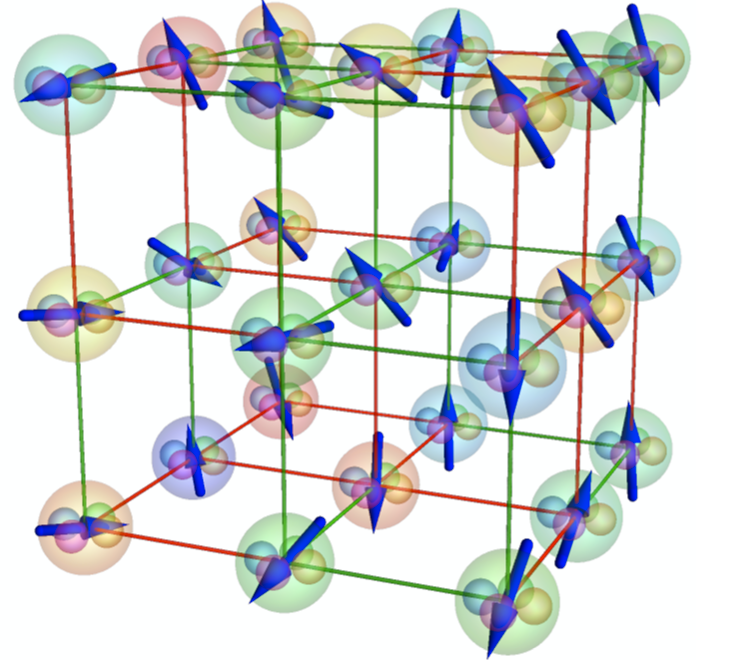
The hyperspin machine: simulating QCD models and dimensional annealing
https://arxiv.org/abs/2203.16190
From condensed matter to quantum chromodynamics, multidimensional spins are a fundamental paradigm, with a pivotal role in combinatorial optimization and machine learning. Machines formed by coupled parametric oscillators can simulate spin models, but only for Ising or low-dimensional spins. Currently, machines implementing arbitrary dimensions remain a challenge. Here, we introduce and validate a hyperspin machine to simulate multidimensional continuous spin models. We realize high-dimensional spins by pumping groups of parametric oscillators, and study NP-hard graphs of hyperspins. The hyperspin machine can interpolate between different dimensions by tuning the coupling topology, a strategy that we call “dimensional annealing”. When interpolating between the XY and the Ising model, the dimensional annealing impressively increases the success probability compared to conventional Ising simulators. Hyperspin machines are a new computational model for combinatorial optimization. They can be realized by off-the-shelf hardware for ultrafast, large-scale applications in classical and quantum computing, condensed-matter physics, and fundamental studies.
Coloquio at the University of Pernambuco on youtube

(Nature) Photonics and the Nobel Prize in Physics 2021


All-Optical Scalable Spatial Coherent Ising Machine

Networks of optical oscillators simulating coupled Ising spins have been recently proposed as a heuristic platform to solve hard optimization problems. These networks, called coherent Ising machines (CIMs), exploit the fact that the collective nonlinear dynamics of coupled oscillators can drive the system close to the global minimum of the classical Ising Hamiltonian, encoded in the coupling matrix of the network. To date, realizations of large-scale CIMs have been demonstrated using hybrid optical-electronic setups, where optical oscillators simulating different spins are subject to electronic feedback mechanisms emulating their mutual interaction. While the optical evolution ensures an ultrafast computation, the electronic coupling represents a bottleneck that causes the computational time to severely depend on the system size. Here, we propose an all-optical scalable CIM with fully programmable coupling. Our setup consists of an optical parametric amplifier with a spatial light modulator (SLM) within the parametric cavity. The spin variables are encoded in the binary phases of the optical wave front of the signal beam at different spatial points, defined by the pixels of the SLM. We first discuss how different coupling topologies can be achieved by different configurations of the SLM, and then benchmark our setup with a numerical simulation that mimics the dynamics of the proposed machine. In our proposal, both the spin dynamics and the coupling are fully performed in parallel, paving the way towards the realization of size-independent ultrafast optical hardware for large-scale computation purposes.
https://journals.aps.org/prapplied/abstract/10.1103/PhysRevApplied.16.054022