Topological Control of Extreme Waves

From optics to hydrodynamics, shock and rogue waves are widespread. Although they appear as distinct phenomena, new theories state that transitions between extreme waves are allowed. However, these have never been experimentally observed because of the lack of control strategies. We introduce a new concept of nonlinear wave topological control, based on the one-to-one correspondence between the number of wave packet oscillating phases and the genus of toroidal surfaces associated with the nonlinear Schrödinger equation solutions by the Riemann theta function. We prove it experimentally by reporting the first observation of supervised transitions between extreme waves with different genera, like the continuous transition from dispersive shock to rogue waves. Specifically, we use a parametric time-dependent nonlinearity to shape the asymptotic wave genus. We consider the box problem in a focusing Kerr-like photorefractive medium and tailor time-dependent propagation coefficients, as nonlinearity and dispersion, to explore each region in the state-diagram and include all the dynamic phases in the nonlinear wave propagation. Our result is the first example of the topological control of integrable nonlinear waves. This new technique casts light on dispersive shock waves and rogue wave generation and can be extended to other nonlinear phenomena, from classical to quantum ones. The outcome is not only important for fundamental studies and control of extreme nonlinear waves, but can be also applied to spatial beam shaping for microscopy, medicine, and spectroscopy, and to the broadband coherent light generation.

Marcucci et al. in ArXiv:1908.05212

Perturbation of Transmission Matrices in nonlinear random media

Random media with tailored optical properties are attracting burgeoning interest for applications in imaging, biophysics, energy, nanomedicine, spectroscopy, cryptography, and telecommunications. A key paradigm for devices based on this class of materials is the transmission matrix, the tensorial link between the input and the output signals, that describes in full their optical behavior. The transmission matrix has specific statistical properties, such as the existence of lossless channels, that can be used to transmit information, and are determined by the disorder distribution. In nonlinear materials, these channels may be modulated and the transmission matrix tuned accordingly. Here, the direct measurement of the nonlinear transmission matrix of complex materials is reported, exploiting the strong optothermal nonlinearity of scattering silica aerogel (SA). It is shown that the dephasing effects due to nonlinearity are both controllable and reversible, opening the road to applications based on the nonlinear response of random media.

Adam Fleming, Claudio Conti, and Andrea Di Falco in Annalen Der Physics

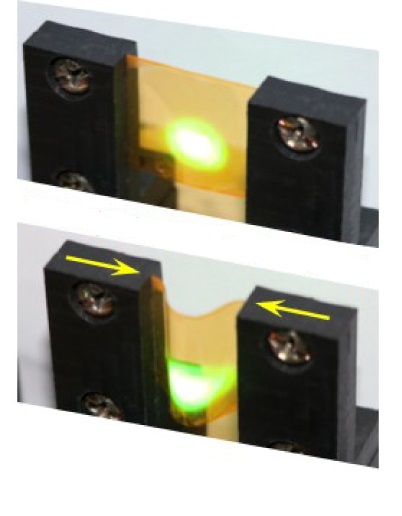
Flexible Organometal Random Lasers

Disorder is emerging as a strategy for fabricating random laser sources with very promising materials, like perovskites, for which standard laser cavities are not effective, or too expensive. We need however different fabrication protocols and technologies for reducing the laser threshold and controlling its emission. Here we demonstrate an effectively solvent-engineered method for high-quality perovskite thin films on the flexible polyimide substrate. The fractal perovskite thin films exhibit excellent optical properties at room temperature and easily achieve lasing action without any laser cavity above room temperature with a low pumping threshold. The lasing action is also observed in curved perovskite thin films on the flexible substrates. The lasing threshold can be further reduced by increasing the local curvature, which modifies the scattering strengths of the bent thin film. We also show that the curved perovskite lasers are extremely robust with respect to repeated deformations. Because of the low spatial coherence, these curved random laser devices are efficient and durable speckle-free light sources for applications in spectroscopy, bio-imaging, and illumination.

Wang et al. in ACS Nano (2019)


See also …

Nonlinear localized waves in curved geometry
Lasing in curved geometry

Graphene oxide photonics

The successful exfoliation of graphite initiated new science in any research field and is employing a huge number of scientists in the world investigating chemical, structural, mechanical and optoelectrical; properties of the atomic-thick sheets of graphene and graphene oxide. Similarly to other carbon-based materials, graphene family have shown exceptional optical responses; and nowadays it is engineered to produce efficient photonic components. In this review we aim to summarize the main results in nonlinear optical response and fluorescence of graphene oxide; moreover, its laser printing is reviewed as a novel promising lithographic technique.

Neda Ghofraniha and Claudio Conti in Journal of Optics


See also …

Deep learning, living, random, optical, and – maybe – useful

In a recent paper, we demonstrated an optical deep neural network with a real living piece of brain tumor (a 3D “tumour model”). We think this is the first example of a hybrid living/photonic hardware: a sort of artificially intelligent device performing optical functions and detecting tumour morphodynamics (including the effect of chemotherapy)

Deep optical neural network by living tumour brain cells

Abstract: The new era of artificial intelligence demands large-scale ultrafast hardware for machine learning. Optical artificial neural networks process classical and quantum information at the speed of light, 
and are compatible with silicon technology, but lack scalability and need expensive manufacturing of many computational layers. New paradigms, as reservoir computing and the extreme learning machine, suggest that disordered and biological materials may realize artificial neural networks with thousands of computational nodes trained only at the input and at the readout. Here we employ biological complex systems, i.e., living three-dimensional tumour brain models, and demonstrate a random neural network (RNN) trained to detect tumour morphodynamics via
image transmission. The RNN, with the tumour spheroid 19 as a three-dimensional deep computational reservoir, performs programmed optical functions and detects cancer morphodynamics from laser-induced hyperthermia inaccessible by optical imaging. Moreover, the RNN quantifies the effect of chemotherapy inhibiting tumour growth. We realize a non-invasive smart probe for cytotoxicity assay, which is at least one order of magnitude more sensitive with respect to conventional imaging. Our random and hybrid photonic/living system is a novel artificial machine for computing and for the real-time investigation of tumour dynamics.

Authors: D. Pierangeli, V. Palmieri, G. Marcucci, C. Moriconi, G. Perini, M. De Spirito, M. Papi, C. Conti

https://arxiv.org/abs/1812.09311