Synchrotron resonant radiation from nonlinear self-accelerating pulses

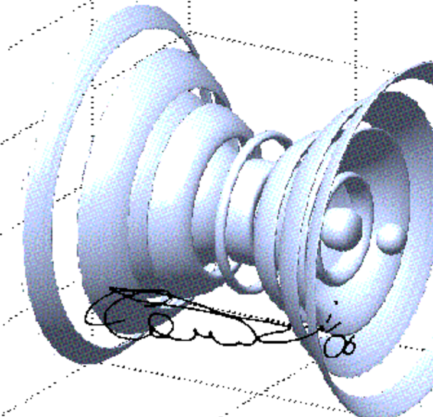
Solitons and nonlinear waves emit resonant radiation in the presence of perturbations. This effect is relevant for nonlinear fiber optics, supercontinuum generation, rogue waves, and complex nonlinear dynamics. However, resonant radiation is narrowband, and the challenge is finding novel ways to generate and tailor broadband spectra. We theoretically predict that nonlinear self-accelerated pulses emit a novel form of synchrotron radiation that is extremely broadband and controllable. We develop an analytic theory and confirm the results by numerical analysis. This new form of supercontinuum generation can be highly engineered by shaping the trajectory of the nonlinear self-accelerated pulses. Our results may find applications in novel highly efficient classical and quantum sources for spectroscopy, biophysics, security, and metrology.

Lifu Zhang, Xiang Zhang, Davide Pierangeli, Ying Li, Dianyuan Fan, and Claudio Conti in Optics Express 26, 14710 (2018)

Quantum X waves with orbital angular momentum in nonlinear dispersive media

We present a complete and consistent quantum theory of generalised X waves with orbital angular momentum in dispersive media. We show that the resulting quantised light pulses are affected by neither dispersion nor diffraction and are therefore resilient against external perturbations. The nonlinear interaction of quantised X waves in quadratic and Kerr nonlinear media is also presented and studied in detail.

M. Ornigotti, C. Conti, and A. Szameit, Journal of Optics 20 (2018) 065201

Solitons and Black Holes in the Sine-Gordon Equation

The intriguing connection between black holes’evaporation and physics of solitons is opening novel roads to finding observable phenomena. It is known from the inverse scattering transform that velocity is a fundamental parameter in solitons theory. Taking this into account, the study of Hawking radiation by a moving soliton gets a growing relevance. However, a theoretical context for the description of this phenomenon is still lacking. Here, we adopt a soliton geometrization technique to study the quantum emission of a moving soliton in a one-dimensional model. Representing a black hole by the one soliton solution of the Sine-Gordon equation, we consider Hawking emission spectra of a quantized massless scalarfield on the soliton-induced metric. We study the relation between the soliton velocity and the black hole temperature. Our results address a new scenario in the detection of new physics in the quantum gravity panorama.

L. Villari, G. Marcucci, M.C. Braidotti and C. Conti, J. Phys. Comm. 2 (2018) 005016

Observation of replica symmetry breaking in disordered nonlinear wave propagation

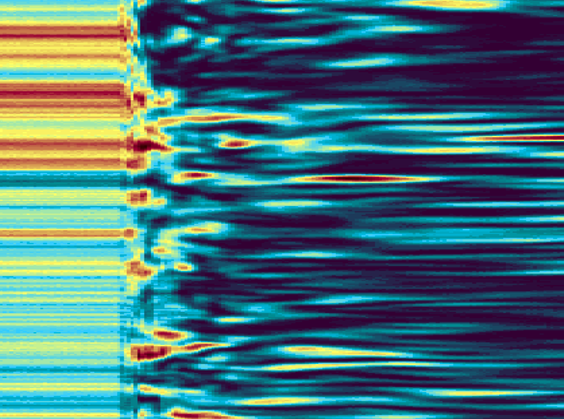
A landmark of statistical mechanics, spin-glass theory describes critical phenomena in disordered systems that range from condensed matter to biophysics and social dynamics. The most fascinating concept is the breaking of replica symmetry: identical copies of the randomly interacting system that manifest completely different dynamics. Replica symmetry breaking has been predicted in nonlinear wave propagation, including Bose-Einstein condensates and optics, but it has never been observed. Here, we report the experimental evidence of replica symmetry breaking in optical wave propagation, a phenomenon that emerges from the interplay of disorder and nonlinearity. When mode interaction dominates light dynamics in a disordered optical waveguide, different experimental realizations are found to have an anomalous overlap intensity distribution that signals a transition to an optical glassy phase. The findings demonstrate that nonlinear propagation can manifest features typical of spin-glasses and provide a novel platform for testing so-far unexplored fundamental physical theories for complex systems.

Davide Pierangeli, Andrea Tavani, Fabrizio Di Mei, Aharon J. Agranat, Claudio Conti, Eugenio Del Re, Nature Communications 8:1501 (2017)

Lasing on nonlinear localized waves in curved geometry

The use of geometrical constraints exposes many new perspectives in photonics and in fundamental studies of nonlinear waves. By implementing surface structures in vertical cavity surface emitting lasers as manifolds for curved space, we experimentally study the impacts of geometrical constraints on nonlinear wave localization. We observe localized waves pinned to the maximal curvature in an elliptical-ring, and confirm the reduction in the localization length of waves by measuring near and far field patterns, as well as the corresponding energy-angle dispersion relation. Theoretically, analyses based on a dissipative model with a parabola curve give good agreement remarkably to experimental measurement on the reduction in the localization length. The introduction of curved geometry allows to control and design lasing modes in the nonlinear regime.

Kou-Bin Hong, Chun-Yan Lin, Tsu-Chi Chang, Wei-Hsuan Liang, Ying-Yu Lai, Chien-Ming Wu, You-Lin Chuang, Tien-Chang Lu, Claudio Conti, and Ray-Kuang Lee in Optics Express 25, 29068 (2017)