Observation of Lump Solitons — after 50 years

https://doi.org/10.1103/ggbs-y21w

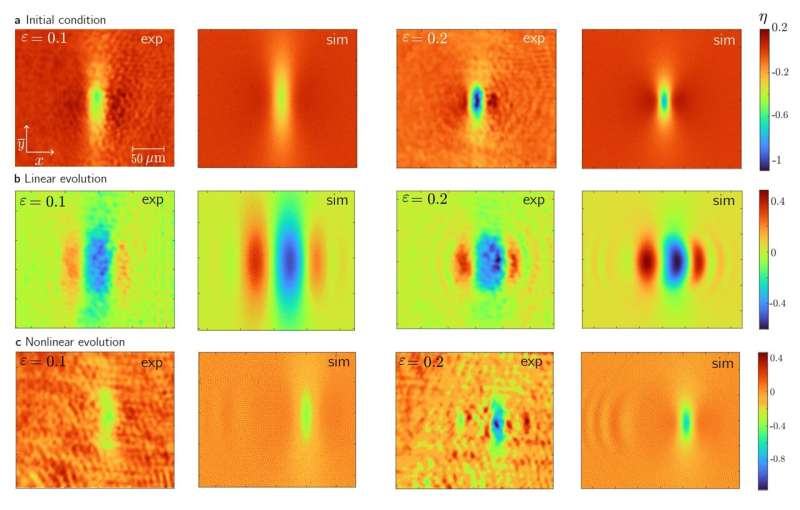
Solitons are the cornerstone of nonlinear physics. The integrability of nonlinear equations is the basis of this universal concept. However, most multidimensional systems lack integrability, a fundamental limitation that challenges the existence of solitons in high dimensions. A remarkable exception would be the lump soliton, a two-dimensional solution of the Kadomtsev-Petviashvili (KP) equation with the unique property of propagating unperturbed in three-dimensional space. Due to the difficulty of implementing the KP dynamics in any physical system, lump solitons have never been observed. Here, we report the first experimental observation of the lump soliton. The lump is realized in nonlinear optics, in a photorefractive crystal under the action of paraxial diffraction and defocusing nonlinearity, ruled by the (2+1)⁢D nonlinear Schrödinger (NLS) equation. We tailor the input field shape and the nonlinearity to realize the hydrodynamic KP integrable regime of the NLS equation. The lump emerges as a self-localized wave that propagates unaltered with a transverse velocity. We confirm its integrable nature by reporting, for the first time, the elastic collision of lumps in two dimensions. As the first experimental evidence of integrable solitons in high dimensions, our observation paves the way for a new era in the study of nonlinear systems.

Featured in Physics, Editors’suggestion

https://physics.aps.org/articles/v19/s22

https://phys.org/news/2026-01-physicists-resilient-3d-solitons-lab.html
Particle trajectories in light pulse spacetime

https://arxiv.org/abs/2507.20203

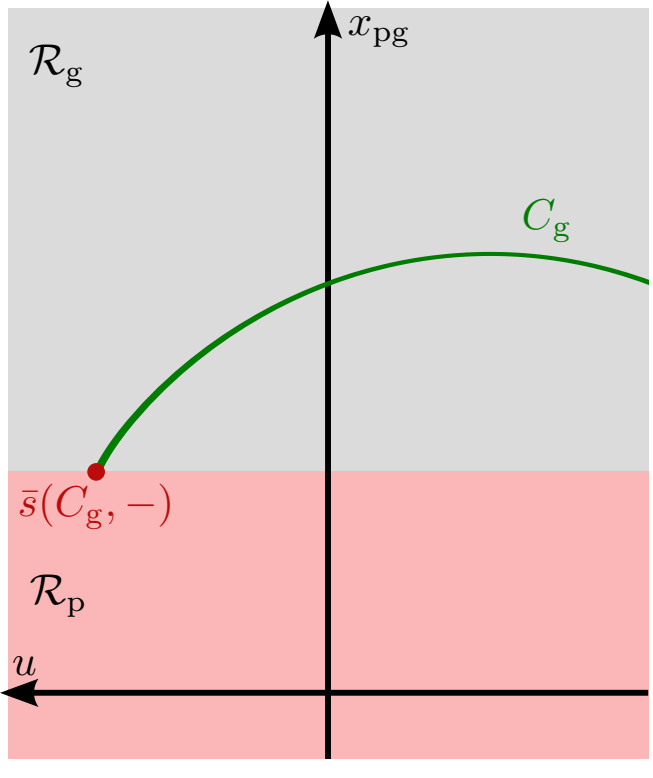
In our previous work (Phys. Rev. Research 7, 033079), we derived the metric tensor for cylindrically shaped pulses with uniform energy density. Building upon that framework, we derive the complete set of geodesics with zero angular velocity. We show that perturbations in particle trajectories may be observed in gamma ray bursts. Also, deviations in the motion of moving particles are significantly larger than those previously found for particles that are initially at rest.

Cumulative effects of laser-generated gravitational shock waves

https://arxiv.org/abs/2503.05001

https://journals.aps.org/prresearch/abstract/10.1103/ylvn-3ybm

The emission of light pulses is expected to generate gravitational waves, opening the possibility of controlling gravity in an Earthed laboratory. However, measuring the optically-driven spacetime deformations is challenging due to the inherently weak interaction. We explore the possibility to achieve a detectable gravitational effect from light emission by examining the cumulative effect of a sequence of laser-generated gravitational shock waves on a test particle. We derive an exact solution to the Einstein equations for cylindrically-shaped optical beams with constant energy density, imposing continuity condition for the metric and its first-order derivatives. Our analysis reveals that laser-induced gravitational fields cause a spatial shift in the test particle, which is measurable within current interferometric technology.

Tensorial flow of mosaic beams in PRL !

https://journals.aps.org/prl/abstract/10.1103/PhysRevLett.132.243801

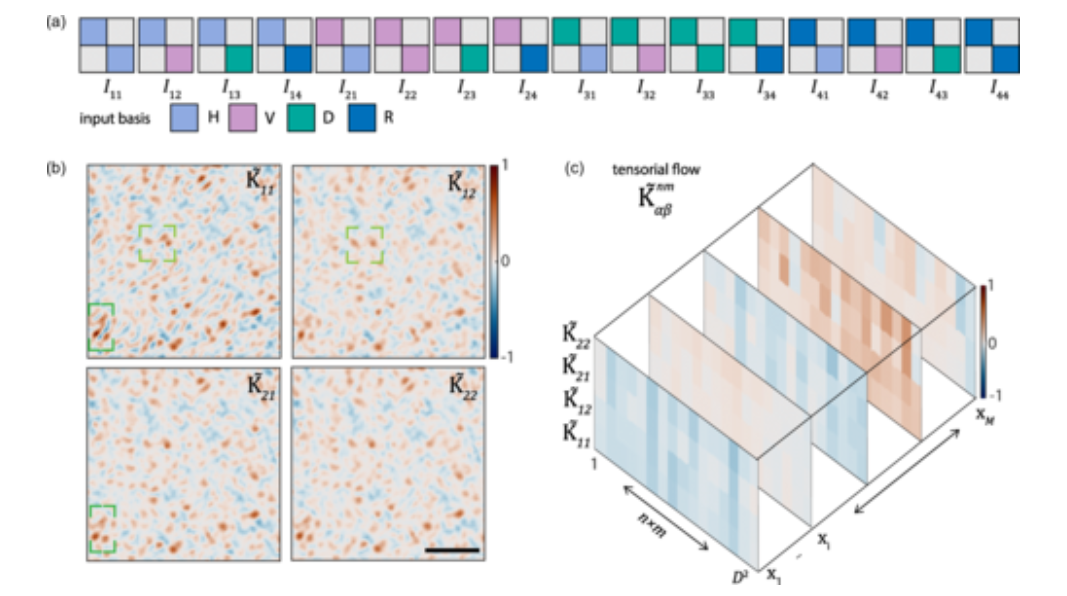
Optical beams with nonuniform polarization offer enhanced capabilities for information transmission, boasting increased capacity, security, and resilience. These beams possess vectorial features that are spatially organized within localized three-dimensional regions, forming tensors that can be harnessed across a spectrum of applications spanning quantum physics, imaging, and machine learning. However, when subjected to the effect of the transmission channel, the tensorial propagation leads to a loss of data integrity due to the entanglement of spatial and polarization degrees of freedom. The challenge of quantifying this spatial-polarization coupling poses a significant obstacle to the utilization of vector beams in turbulent environments, multimode fibers, and disordered media. Here, we introduce and experimentally investigate mosaic vector beams, which consist of localized polarization tesserae that propagate in parallel, demonstrating accurate measurement of their behavior as they traverse strongly disordered channels and decoding their polarization structure in single-shot experiments. The resultant transmission tensor empowers polarization-based optical communication and imaging in complex media. These findings also hold promise for photonic machine learning, where the engineering of tensorial flow can enable optical computing with high throughput.

Biosensing with free space whispering gallery mode microlasers

Highly accurate biosensors for few or single molecule detection play a central role in numerous key fields, such as healthcare and environmental monitoring. In the last decade, laser biosensors have been investigated as proofs of concept, and several technologies have been proposed. We here propose a demonstration of polymeric whispering gallery microlasers as biosensors for detecting small amounts of proteins down to 400 pg. They have the advantage of working in free space without any need for waveguiding for input excitation or output signal detection. The photonic microsensors can be easily patterned on microscope slides and operate in air and solution. We estimate the limit of detection up to 148 nm/RIU for three different protein dispersions. In addition, the sensing ability of passive spherical resonators in the presence of dielectric nanoparticles that mimic proteins is described by massive ab initio numerical simulations.

https://doi.org/10.1364/PRJ.477139