
Category: Projects
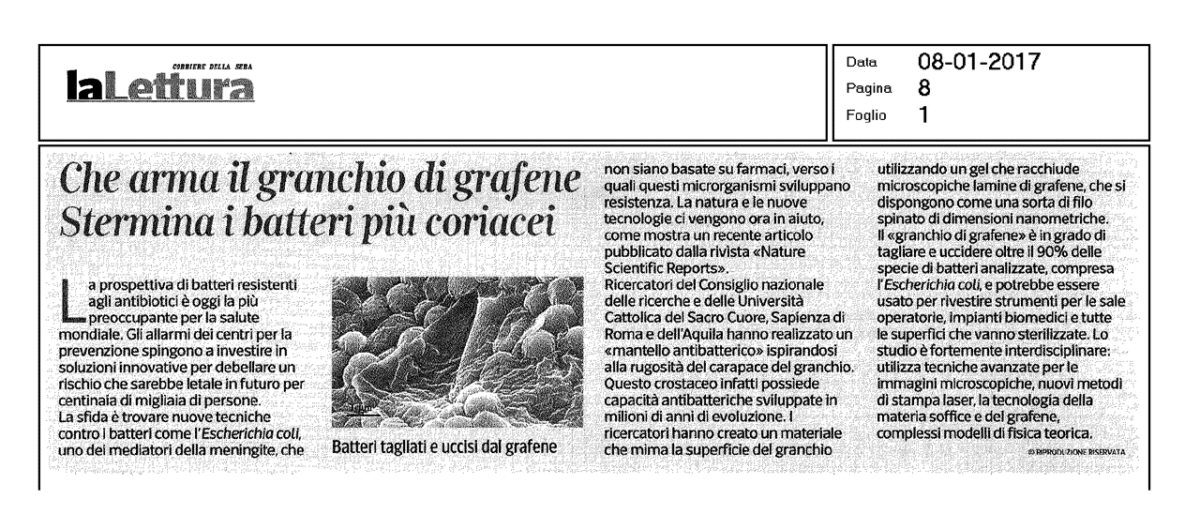
Antibacterial action of graphene oxide, web and press release
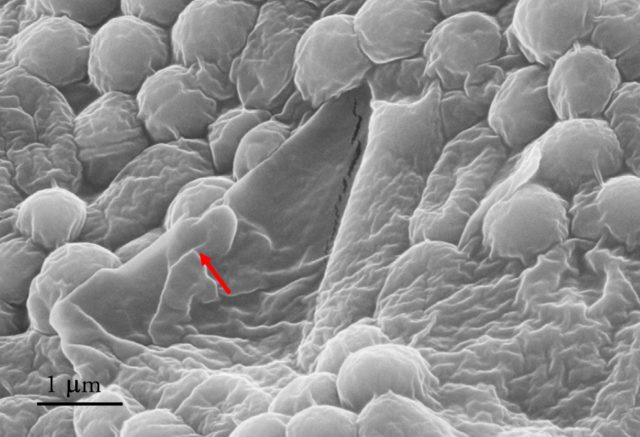

Graphene Pagurus Versus Super Bugs

The super bugs are the plague of modern era. Super bugs are antibiotic resistant bacteria that will cause the death of thousands of people in the future. We need novel tools to sterilize surfaces and medical equipment; we also need novel approaches to defeat bacteria.
Within a collaboration with the University Cattolica, we recently reported in Scientific Reports on a novel “cloak” against super bugs. The cloak is a laser printed surface that includes graphene oxide. The cloak is able to kill the bacteria because the surface mimics the carapace of the Cancer Pagurus (picture above), which is known to repel dangerous organisms, and also uses graphene as a blade that cuts the bacteria (and also wrap and poison them), as in the following picture
The cloak is a novel very effective solution to sterilize surfaces, and our research sheds light on the effect of graphene against bacteria. We report 90% bacteria killing action.
Web release
http://www.graphene-info.com/graphene-oxide-helps-creating-antibacterial-cloack
http://lucbourne.scienceblog.com/74/treating-biofilms-to-an-antimicrobial-cloak/
Press release on the VANGUARD project
At minute 7,15

The results of the team of the Vanguard project presented at at the 60th annual meeting of the Biophysical Society, in Los Angeles appeared in Physics World
http://nanotechweb.org/cws/article/tech/64211
http://www.azonano.com/news.aspx?newsID=34445
https://cosmosmagazine.com/technology/five-new-uses-miracle-material-graphene
http://www.directorstalk.com/graphene-oxide-could-help-fight-hospital-acquired-infections-2/
http://www.milanofinanza.it/articoli/i-nuovi-killer-di-batteri-2075304?preview=false&access=FA
The research has been spotted by the Dailymail !
Other press release:
http://www.liberoquotidiano.it/news/salute/11893222/Funghi-e-batteri-killer-in-ospedale.html
Press Release in Italian “Donna del Corriere della Sera”

Press release in the Netherlands

Press release in Japan !

Black holes evaporate, black holes are solitons, solitons evaporate !

The fact that black holes are solitons is not very well known. Abdus Salam and others outlined this issue several years ago. Stephen Hawking predicted that Black Holes evaporate, and this is a quantum effect on classical gravity governed by the highly nonlinear Einstein-Hilbert equations.
Leone Villari, Ewan Wright, Fabio Biancalana and Claudio Conti report on the possibility that all types of classical solitons may evaporate in the quantum regime. A paper in the arXiv contains the theory on the exact quantization of the nonlinear Schroedinger equation: solitons emit a blackbody radiation spectrum at a temperature given by the same formula of Hawking!
This result is intriguing. On one hand, because it represents the first theoretical prediction of the Hawking radiation in a fully nonlinear quantum field theory. The standard Hawking theory relies on the quantization of a linear field in a curved background. The theory may hence provide insights for a true quantum gravity based on the complete quantization of the Einstein-Hilbert equations.
On the other hand, the result is also important because the Hawking radiation from a quantum soliton may furnish a novel highly tunable quantum source with many possible applications.