Boson sampling solitons by quantum machine learning

https://arxiv.org/abs/2110.12379

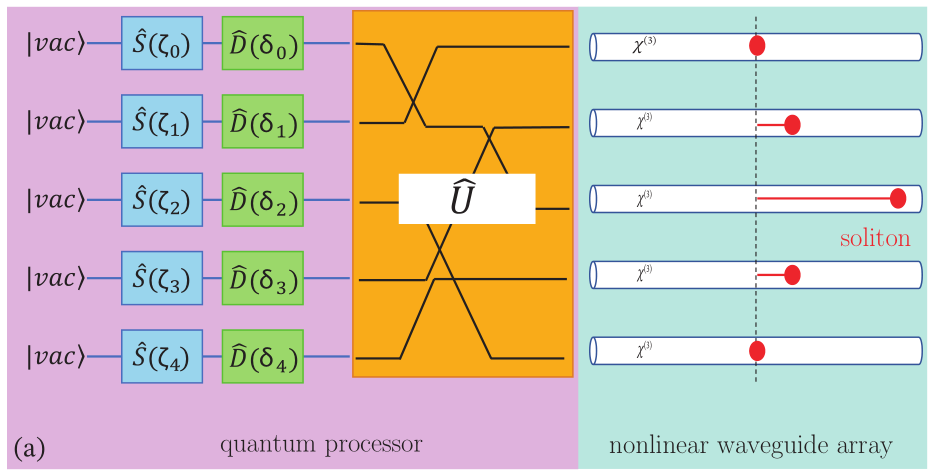
We use a neural network variational ansatz to compute Gaussian quantum discrete solitons in an array of waveguides described by the quantum discrete nonlinear Schroedinger equation. By training the quantum machine learning model in the phase space, we find different quantum soliton solutions varying the number of particles and interaction strength. The use of Gaussian states enables measuring the degree of entanglement and the boson sampling patterns. We compute the probability of generating different particle pairs when varying the soliton features and unveil that bound states of discrete solitons emit correlated pairs of photons. These results may have a role in boson sampling experiments with nonlinear systems and in developing quantum processors to generate entangled many-photon nonlinear states.

Quantum machine learning and boson sampling

Training Gaussian boson sampling by quantum machine learning

published in Quantum Machine Intelligence 3, 26 (2021)

Pseudocode

We use neural networks to represent the characteristic function of many-body Gaussian states in the quantum phase space. By a pullback mechanism, we model transformations due to unitary operators as linear layers that can be cascaded to simulate complex multi-particle processes. We use the layered neural networks for non-classical light propagation in random interferometers, and compute boson pattern probabilities by automatic differentiation. This is a viable strategy for training Gaussian boson sampling. We demonstrate that multi-particle events in Gaussian boson sampling can be optimized by a proper design and training of the neural network weights. The results are potentially useful to the creation of new sources and complex circuits for quantum technologies.

https://doi.org/10.1007/s42484-021-00052-y

Ciao Erasmo

Two days ago, on the 14th of July 2021, one of the most influential professors I met in my career had passed away. Erasmo Recami has been an example of what being a scientist means. Never looking for the scene, but always studying, doing research, and answering by knowledge and writing.

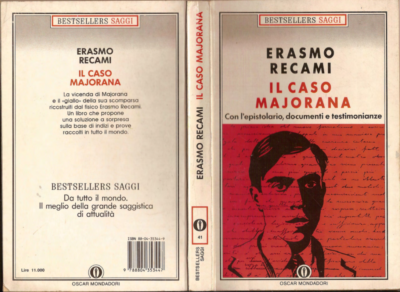
Erasmo has contributed to so many subjects that are difficult to summarize. From the problem of time to the discovery of tachyons, which inspired the research on X-waves in optics and other fields. He started the legend of Majorana by his investigations and his famous books.

I have always appreciated his way of interacting with young scientists, discussing friendly and open-minded on many subjects. How important is confronting expert people for motivated young researchers!

Years ago, in 2008, he participated in a workshop on nonlinear waves I organized in Rome. I still remember him presenting old-school slides in a lamp projector. Those slides were dense with historical references and knowledge. Thanks, Erasmo! I hope to meet many other persons like you in my life.