Ciao Erasmo

Two days ago, on the 14th of July 2021, one of the most influential professors I met in my career had passed away. Erasmo Recami has been an example of what being a scientist means. Never looking for the scene, but always studying, doing research, and answering by knowledge and writing.

Erasmo has contributed to so many subjects that are difficult to summarize. From the problem of time to the discovery of tachyons, which inspired the research on X-waves in optics and other fields. He started the legend of Majorana by his investigations and his famous books.

I have always appreciated his way of interacting with young scientists, discussing friendly and open-minded on many subjects. How important is confronting expert people for motivated young researchers!

Years ago, in 2008, he participated in a workshop on nonlinear waves I organized in Rome. I still remember him presenting old-school slides in a lamp projector. Those slides were dense with historical references and knowledge. Thanks, Erasmo! I hope to meet many other persons like you in my life.

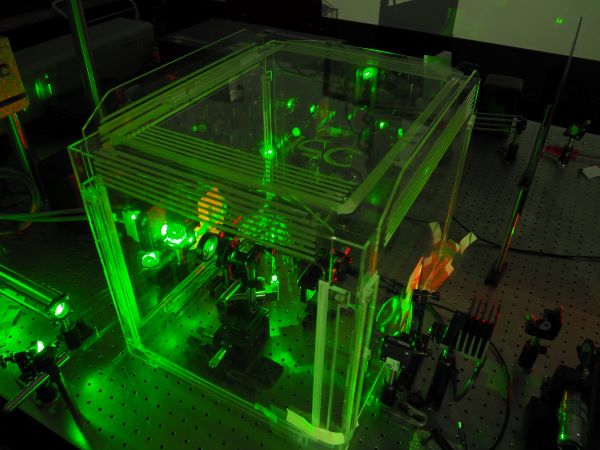
Photonic extreme learning machine by free-space optical propagation

Photonic brain-inspired platforms are emerging as novel analog computing devices, enabling fast and energy-efficient operations for machine learning. These artificial neural networks generally require tailored optical elements, such as integrated photonic circuits, engineered diffractive layers, nanophotonic materials, or time-delay schemes, which are challenging to train or stabilize. Here we present a neuromorphic photonic scheme – photonic extreme learning machines – that can be implemented simply by using an optical encoder and coherent wave propagation in free space. We realize the concept through spatial light modulation of a laser beam, with the far field that acts as feature mapping space. We experimentally demonstrated learning from data on various classification and regression tasks, achieving accuracies comparable to digital extreme learning machines. Our findings point out an optical machine learning device that is easy-to-train, energetically efficient, scalable and fabrication-constraint free. The scheme can be generalized to a plethora of photonic systems, opening the route to real-time neuromorphic processing of optical data.

arXiv:2105.12123

Photonics Research 9, 1446 (2021)