Machine Learning Photonics 2021

Lake Como School of Advanced Photonics https://mlph.lakecomoschool.org/

NEW DATE: MARCH 15-19, 2021

The school brings together experts in emerging photonic technologies, machine learning techniques, and fundamental physics who will share with young researchers their knowledge and interdisciplinary approaches for understanding and designing complex photonic systems and their practical applications.  In the new era of artificial intelligence, algorithms and computational interfaces are broadly emerging as novel tools to do scientific research. The paradigms of machine learning also inspire interpretations and methodologies, in both theories and experiments. Nonlinear, quantum and bio-photonics, as well as optical communications, are surprisingly influenced by these new ideas. The summer school is aimed to explore machine learning applications in the specific fields of nonlinear optics and photonics.

The areas covered include, but are not limited to: machine learning methods and complexity of optical communication systems, including topics such as the nonlinear Fourier transform and transmission over multimode fibres; complexity in quantum systems emulated in photonics (including optical computing); complexity of emerging novel materials, device and components such as micro-resonators and plasmonic nanostructures. Importantly, the complexity in bio-medical photonic applications will be also considered as a high priority topic.

The summer school will focus on comprehensive review talks from major figures in complementary areas of photonics and machine learning. Invited speakers will deliver one or more 1-hour lectures over 5 days. We shall select up to 30 participants from the pool of most vibrant PhD students and postdocs, with a special focus on Marie Curie Fellows as future leaders of European photonics science and industry. 

See also
Theory of neuromorphic computing by waves

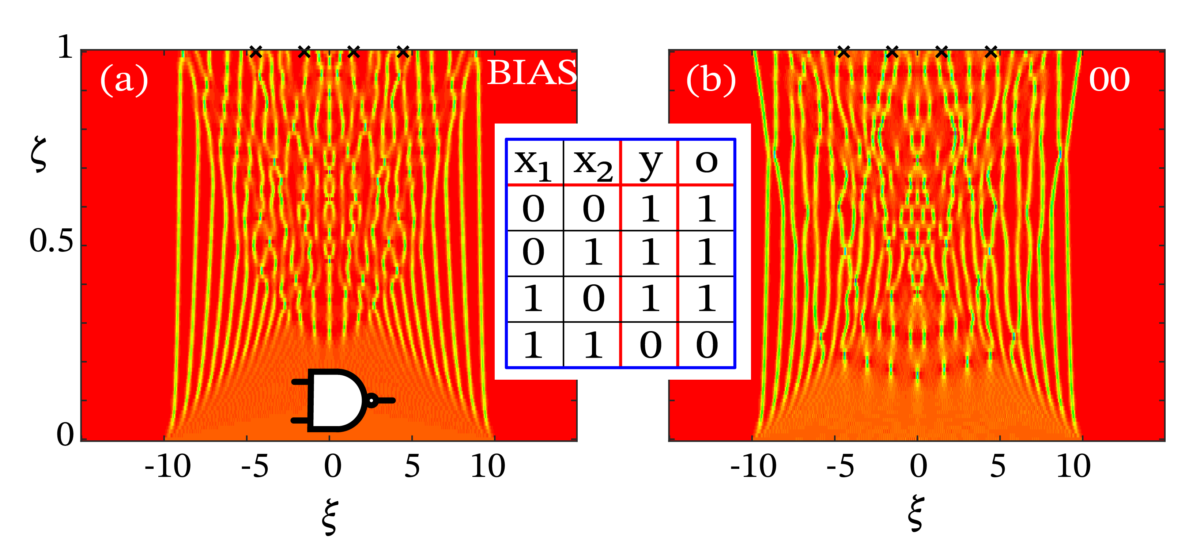
Machine-learning by rogue waves, dispersive shocks, and solitons

We study artificial neural networks with nonlinear waves as a computing reservoir. We discuss universality and the conditions to learn a dataset in terms of output channels and nonlinearity. A feed-forward three-layer model, with an encoding input layer, a wave layer, and a decoding readout, behaves as a conventional neural network in approximating mathematical functions, real-world datasets, and universal Boolean gates. The rank of the transmission matrix has a fundamental role in assessing the learning abilities of the wave. For a given set of training points, a threshold nonlinearity for universal interpolation exists. When considering the nonlinear Schroedinger equation, the use of highly nonlinear regimes implies that solitons, rogue, and shock waves do have a leading role in training and computing. Our results may enable the realization of novel machine learning devices by using diverse physical systems, as nonlinear optics, hydrodynamics, polaritonics, and Bose-Einstein condensates. The application of these concepts to photonics opens the way to a large class of accelerators and new computational paradigms. In complex wave systems, as multimodal fibers, integrated optical circuits, random, topological devices, and metasurfaces, nonlinear waves can be employed to perform computation and solve complex combinatorial optimization.

ArXiv:1912.07077

Simulating general relativity and non-commutative geometry by nonparaxial quantum fluids

We show that quantum fluids enable experimental analogs of relativistic orbital precession in the presence of non-paraxial effects. The analysis is performed by the hydrodynamic limit of the Schroedinger equation. The non-commutating variables in the phase-space produce a precession and an acceleration of the orbital motion. The precession of the orbit is formally identical to the famous orbital precession of the perihelion of Mercury used by Einstein to validate the corrections of general relativity to Newton’s theory. In our case, the corrections are due to the modified uncertainty principle. The results may enable novel relativistic analogs in the laboratory, also including sub Planckian phenomenology.

https://iopscience.iop.org/article/10.1088/1367-2630/ab5da8
