

In a paper published in Optics Express, M. Saleh, C. Conti, and F. Biancalana, report on a new scenario during rogue wave generation. The random intensity profile of an optical pulse fosters Anderson localization of waves that triggers the generation of solitons (the so-called solitonization) and ultimately rogue events. The process also involves event horizons in analogy with black holes. This is a further evidence of the complexity of supercontinuum generation and extreme events in nonlinear fibre optics.
Author: claudio
COMPLEXPHOTONICS 2017, BEST WORKSHOP EVER !

The FIRST meeting on Complex Photonics in Mumbai, organized by Sushil Mujumdar and colleagues at TIFR
How emotional talking with students with 30 hrs train ride to listen to the speaker and presenting their poster ! Science is great !
Highlight in Europhysics News 2016

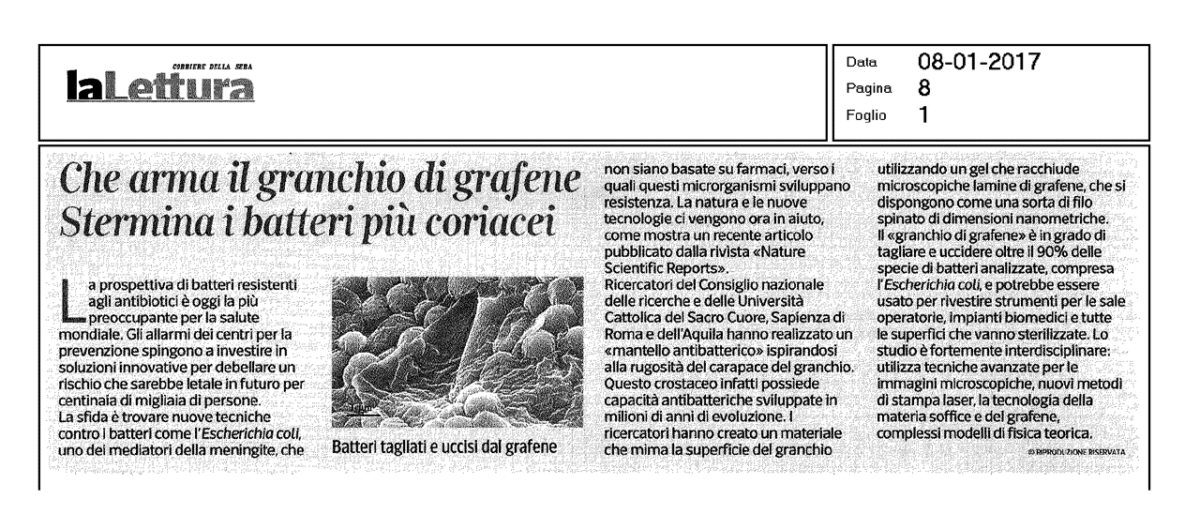
Graphene Pagurus in the Corriere della Sera !
Solitonization of the Anderson localization

Solitons and disorder-induced Anderson states are two apparently unrelated forms of wave localization, the former being due to nonlinearity and the latter to linear disorder.
However, on closer inspection, solitons and disorder induced localized states have similarities: exponential localization, negative eigenvalues, any possible position in space. In the presence of nonlinearity, disorder-induced localizations are expected to have eigenvalue and localization length dependent on power. These states, however, also exist for a negligible nonlinearity: Hence, in the low fluence regime, they are linear Anderson localizations, but at high fluence, they become related to solitons.
In Physical Review A, we analytically and numerically study the process of “solitonization of the Anderson localization,” that is smooth transition from disorder induced to nonlinearity induced wave localization in random media.