Lectures on our Come Lake school on Machine Learning and Photonics are now available on Youtube!
Stay tuned for the new edition next years (hopefully on site and in person!)
Read many books for many years

Lectures on our Come Lake school on Machine Learning and Photonics are now available on Youtube!
Stay tuned for the new edition next years (hopefully on site and in person!)
Many developments in science and engineering depend on tackling complex optimizations on large scales. The challenge motivates an intense search for specific computing hardware that takes advantage of quantum features, nonlinear dynamics, or photonics. A paradigmatic optimization problem is to find low-energy states in classical spin systems with fully random interactions. To date, no alternative computing platform can address such spin-glass problems on a large scale. Here, we propose and realize an optical scalable spin-glass simulator based on spatial light modulation and multiple light scattering. By tailoring optical transmission through a disordered medium, we optically accelerate the computation of the ground state of large spin networks with all-to-all random couplings. Scaling of the operation time with the problem size demonstrates an optical advantage over conventional computing. Our results highlight optical vector-matrix multiplication as a tool for spin-glass problems and provide a general route toward large-scale computing that exploits speed, parallelism, and coherence of light.
We study the Aharonov-Bohm caging effect in a one-dimensional lattice of theta-shaped units defining a chain of interconnected plaquettes, each one threaded by two synthetic flux lines. In the proposed system, light trapping results from the destructive interference of waves propagating along three arms, this implies that the caging effect is tunable and it can be controlled by changing the tunnel couplings J. These features reflect on the diffraction pattern allowing to establish a clear connection between the lattice topology and the resulting AB interference.
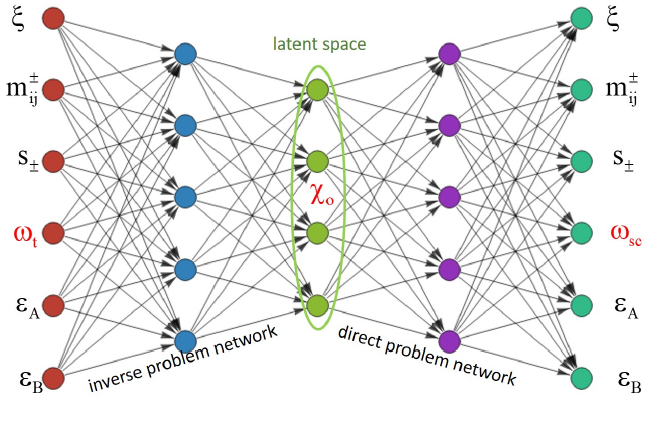
We propose the use of artificial neural networks to design and characterize photonic topological insulators. As a hallmark, the band structures of these systems show the key feature of the emergence of edge states, with energies lying within the energy gap of the bulk materials and localized at the boundary between regions of distinct topological invariants. We consider different structures such as one-dimensional photonic crystals, PT-symmetric chains and cylindrical systems and show how, through a machine learning application, one can identify the parameters of a complex topological insulator to obtain protected edge states at target frequencies. We show how artificial neural networks can be used to solve the long standing quest of inverse-problems solution and apply it to the cutting edge topic of topological nanophotonics.
Pilozzi et al 2020 Nanotechnology https://doi.org/10.1088/1361-6528/abd508
Combinatorial optimization problems are crucial for widespread applications but remain difficult to solve on a large scale with conventional hardware. Novel optical platforms, known as coherent or photonic Ising machines, are attracting considerable attention as accelerators on optimization tasks formulable as Ising models. Annealing is a well-known technique based on adiabatic evolution for finding optimal solutions in classical and quantum systems made by atoms, electrons, or photons. Although various Ising machines employ annealing in some form, adiabatic computing on optical settings has been only partially investigated. Here, we realize the adiabatic evolution of frustrated Ising models with 100 spins programmed by spatial light modulation. We use holographic and optical control to change the spin couplings adiabatically, and exploit experimental noise to explore the energy landscape. Annealing enhances the convergence to the Ising ground state and allows to find the problem solution with probability close to unity. Our results demonstrate a photonic scheme for combinatorial optimization in analogy with adiabatic quantum algorithms and classical annealing methods but enforced by optical vector-matrix multiplications and scalable photonic technology.
https://www.osapublishing.org/optica/fulltext.cfm?uri=optica-7-11-1535&id=442147
See also https://arxiv.org/abs/2005.08690