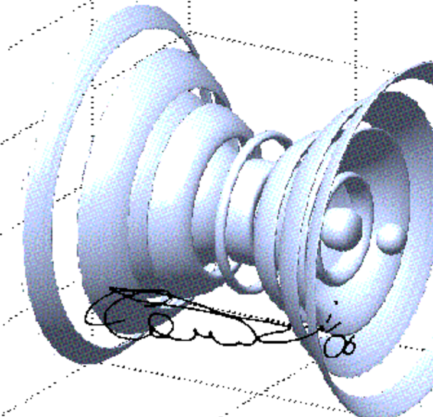
Marco Ornigotti, Claudio Conti and Alex Szameit develop a rigorous theory of propagation invariant “X-wave” pulses with orbital angular momentum. These new photon states form and propagate in quadratic and cubic nonlinear media, and represent a novel tool for quantum information and entanglement. X-waves also allow a new 3D+1 representation of the propagation of light in nonlinear media as a spinning quantum fluid.
Category: Nonlinear Physics
Solitons and quantum gravity in the Hawking radiation
The fact that solitons may have a role in quantum gravity is intriguing.
In a paper in ArXiv, by Leone Di Mauro Villari, Giulia Marcucci, Maria Chiara Braidotti (all of them top complexlight students), and CC, a toy model concerning Hawking radiation by moving black holes is proposed.
Within a simple one-dimensional theory, based on solitons of the Sine-Gordon equation, the authors claim that Hawking emission may be extracted by the concomitant observation of gravitational and electromagnetic waves emitted by colliding black holes. The effect is due to the black-hole-velocity dependent emission spectrum (figure above), which results into an electromagnetic frequency chirp detected by the observer.
Solitonization of the Anderson localization and rogue waves
In a paper published in Optics Express, M. Saleh, C. Conti, and F. Biancalana, report on a new scenario during rogue wave generation. The random intensity profile of an optical pulse fosters Anderson localization of waves that triggers the generation of solitons (the so-called solitonization) and ultimately rogue events. The process also involves event horizons in analogy with black holes. This is a further evidence of the complexity of supercontinuum generation and extreme events in nonlinear fibre optics.
Solitonization of the Anderson localization
Solitons and disorder-induced Anderson states are two apparently unrelated forms of wave localization, the former being due to nonlinearity and the latter to linear disorder.
However, on closer inspection, solitons and disorder induced localized states have similarities: exponential localization, negative eigenvalues, any possible position in space. In the presence of nonlinearity, disorder-induced localizations are expected to have eigenvalue and localization length dependent on power. These states, however, also exist for a negligible nonlinearity: Hence, in the low fluence regime, they are linear Anderson localizations, but at high fluence, they become related to solitons.
In Physical Review A, we analytically and numerically study the process of “solitonization of the Anderson localization,” that is smooth transition from disorder induced to nonlinearity induced wave localization in random media.
Turbulent Transitions in Optical Wave Propagation
In a paper published in Phys. Rev. Lett. , D. Pierangeli, F. Di Mei, G. Di Domenico, A. J. Agranat, C. Conti, and E. Del Re, report the direct observation of the onset of turbulence in propagating one-dimensional optical waves. The transition occurs as the disordered hosting material passes from being linear to one with extreme nonlinearity. As the response grows, increased wave interaction causes a modulational unstable quasihomogeneous flow to be superseded by a chaotic and spatially incoherent one. Statistical analysis of high-resolution wave behavior in the turbulent regime unveils the emergence of concomitant rogue waves. The transition, observed in a photorefractive ferroelectric crystal, introduces a new and rich experimental setting for the study of optical wave turbulence and information transport in conditions dominated by large fluctuations and extreme nonlinearity.