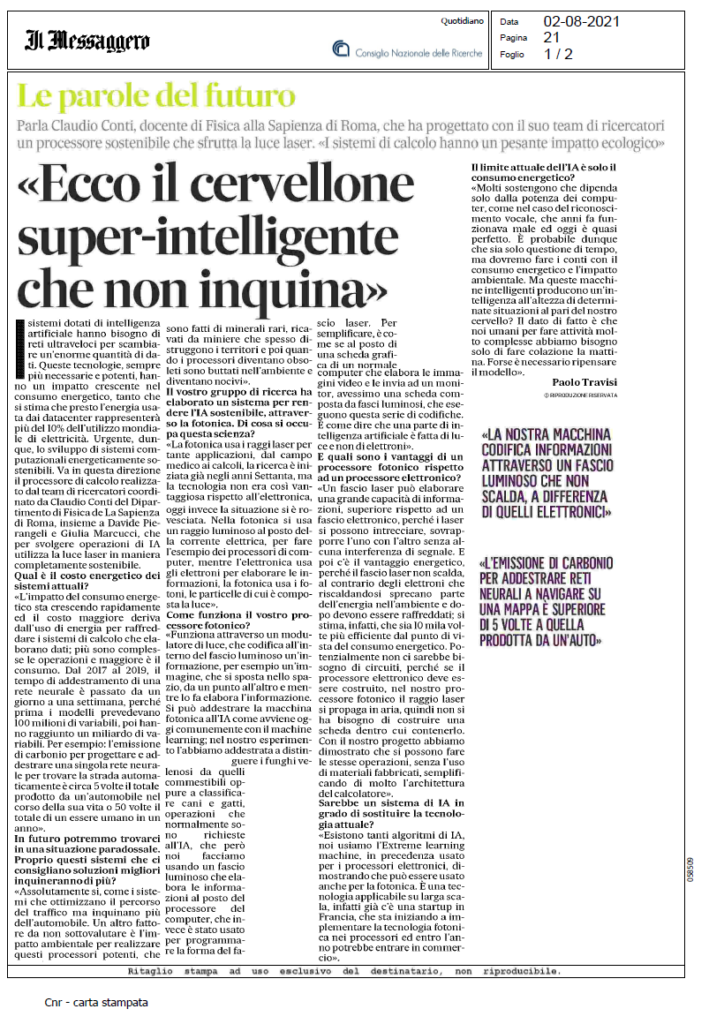
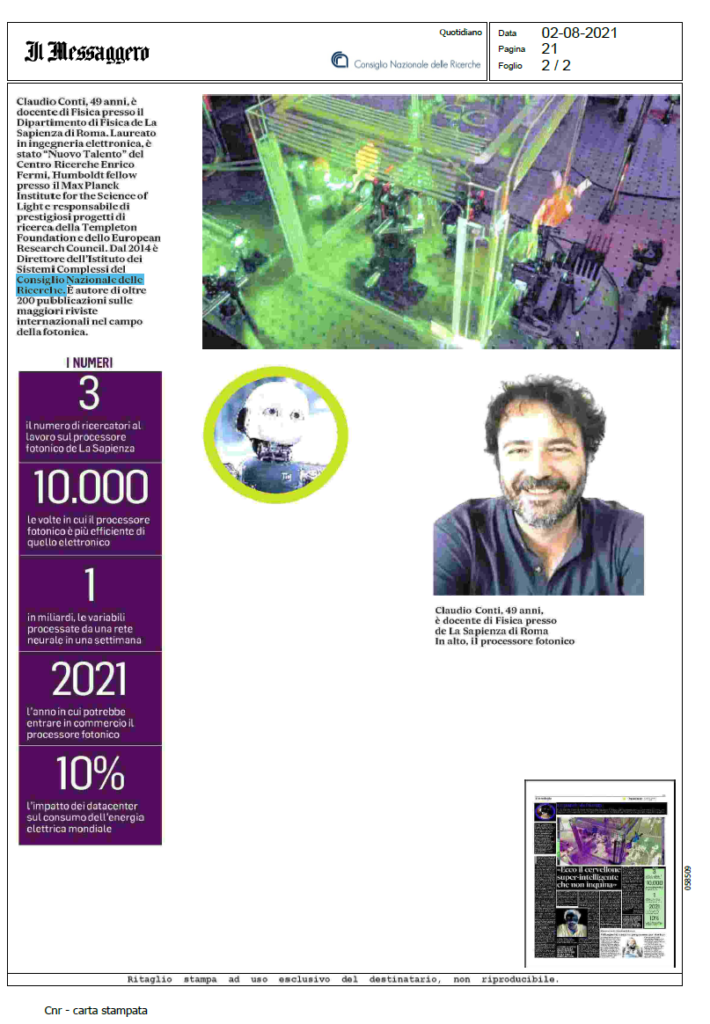
Corriere della Sera 23 agosto 2021
Read many books for many years

Corriere della Sera 23 agosto 2021
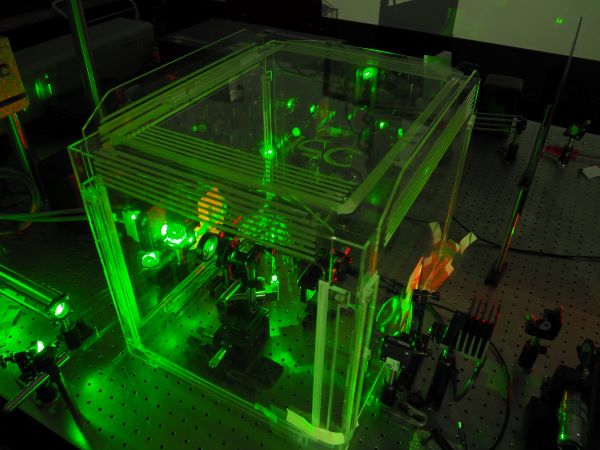
Photonic brain-inspired platforms are emerging as novel analog computing devices, enabling fast and energy-efficient operations for machine learning. These artificial neural networks generally require tailored optical elements, such as integrated photonic circuits, engineered diffractive layers, nanophotonic materials, or time-delay schemes, which are challenging to train or stabilize. Here we present a neuromorphic photonic scheme – photonic extreme learning machines – that can be implemented simply by using an optical encoder and coherent wave propagation in free space. We realize the concept through spatial light modulation of a laser beam, with the far field that acts as feature mapping space. We experimentally demonstrated learning from data on various classification and regression tasks, achieving accuracies comparable to digital extreme learning machines. Our findings point out an optical machine learning device that is easy-to-train, energetically efficient, scalable and fabrication-constraint free. The scheme can be generalized to a plethora of photonic systems, opening the route to real-time neuromorphic processing of optical data.
(Image above from Unsplash collection by Spentys )
Our new project within the Graphene Flagship ( Flagera Call JTC 2019) officially started !
MARGO stands for MAxillofacial bone Regeneration by 3D-printed laser-activated Graphene Oxide Scaffolds
MARGO is an exciting data-driven interdisciplinary research on our previous results on the Antibacterial coating and stem cell replication by Graphene Oxide, following our ERC PoC Project VANGUARD!
See also
Since the 80s we know how to build optical neural networks that simulate the Hopfield model, spin-glasses, and related. New developments in optical technology and light control in random media clearly demonstrate the “optical advantage,” even while limiting to the good old classical physics.

Scalable spin-glass optical simulator
Many developments in science and engineering depend on tackling complex optimizations on large scales. The challenge motivates an intense search for specific computing hardware that takes advantage of quantum features, stochastic elements, nonlinear dissipative dynamics, in-memory operations, or photonics. A paradigmatic optimization problem is finding low-energy states in classical spin systems with fully-random interactions. To date, no alternative computing platform can address such spin-glass problems on a large scale. Here we propose and realize an optical scalable spin-glass simulator based on spatial light modulation and multiple light scattering. By tailoring optical transmission through a disordered medium, we optically accelerate the computation of the ground state of large spin networks with all-to-all random couplings. Scaling of the operation time with the problem size demonstrates an optical advantage over conventional computing. Our results provide a general route towards large-scale computing that exploits speed, parallelism, and coherence of light.