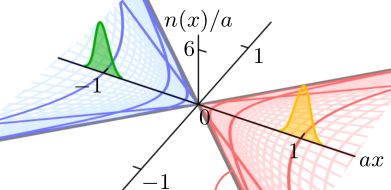
How does an arbitrary quantum state appear to an accelerated observer?

Quantum field theory beyond Minkowski is still largely unexplored, and the links with quantum information are surprising.

We know that the Minkowski vacuum appears as a thermal state in a uniformly accelerated frame (Rindler/Unruh) or in the proximity of a black hole (Hawking).

Beyond Unruh and Hawking radiation, how do quantum states appear to a noninertial observer? We derive a general technique to understand the way acceleration alters Minkowski-Fock states. It turns out that one can use and engineer quantum correlations to measure acceleration. But a lot of work is still needed with advanced mathematical approaches, although these new general results may be useful for many applications.

Minkowski-Fock states in accelerated frames
Riccardo Falcone and Claudio Conti
URL: https://link.aps.org/doi/10.1103/PhysRevD.106.045013
DOI: 10.1103/PhysRevD.106.045013
ArXiv:2208.03481 [hep-th]

An explicit Wigner formulation of Minkowski particle states for non-inertial observers is unknown. Here, we derive a general prescription to compute the characteristic function for Minkowski-Fock states in accelerated frames. For the special case of single-particle and two-particle states, this method enables to derive mean values of particle numbers and correlation function in the momentum space, and the way they are affected by the acceleration of the observer. We show an indistinguishability between Minkowski single-particle and two-particle states in terms of Rindler particle distribution that can be regarded as a way for the observer to detect any acceleration of the frame. We find that for two-particle states the observer is also able to detect acceleration by measuring the correlation between Rindler particles with different momenta. 

Experiments confirm the Non-Abelian Thouless pumping !

Sun et al. in Nature Physics recently reported the experimental observation of the Non-Abelian Thouless pumping by Brosco et al. in Physical Review A.

See also

The experiments in Nature Physics: https://www.nature.com/articles/s41567-022-01669-x

The News and Views by Brosco and Pilozzi :

https://www.nature.com/articles/s41567-022-01675-z

Variational quantum algorithm for Gaussian discrete solitons and their boson sampling

In the context of quantum information, highly nonlinear regimes, such as those supporting solitons, are marginally investigated. We miss general methods for quantum solitons, although they can act as entanglement generators or as self-organized quantum processors. We develop a computational approach that uses a neural network as a variational ansatz for quantum solitons in an array of waveguides. By training the resulting phase-space quantum machine learning model, we find different soliton solutions varying the number of particles and interaction strength. We consider Gaussian states that enable measuring the degree of entanglement and sampling the probability distribution of many-particle events. We also determine the probability of generating particle pairs and unveil that soliton bound states emit correlated pairs. These results may have a role in boson sampling with nonlinear systems and in quantum processors for entangled nonlinear waves

https://arxiv.org/abs/2110.12379

https://link.aps.org/doi/10.1103/PhysRevA.106.013518

Observing quantum particles beyond the horizon

Relativistic quantum information

We show that Minkowski single-particle states localized beyond the horizon modify the Unruh thermal distribution in an accelerated frame. This means that, contrary to classical predictions, accelerated observers can reveal particles emitted beyond the horizon. The method we adopt is based on deriving the explicit Wigner characteristic function for the complete description of the quantum field in the non-inertial frame and can be generalized to general states

https://arxiv.org/abs/2205.03312

Nonlocality-induced surface localization in Bose-Einstein condensates of light

The ability to create and manipulate strongly correlated quantum many-body states is of central importance to the study of collective phenomena in several condensed-matter systems. In the last decades, a great amount of work has been focused on ultracold atoms in optical lattices, which provide a flexible platform to simulate peculiar phases of matter both for fermionic and bosonic particles. The recent experimental demonstration of Bose-Einstein condensation (BEC) of light in dye-filled microcavities has opened the intriguing possibility to build photonic simulators of solid-state systems, with potential advantages over their atomic counterpart. A distinctive feature of photon BEC is the thermo-optical nature of the effective photon-photon interaction, which is intrinsically nonlocal and can thus induce interactions of arbitrary range. This offers the opportunity to systematically study the collective behavior of many-body systems with tunable interaction range. In this paper, we theoretically study the effect of nonlocal interactions in photon BEC. We first present numerical results of BEC in a double-well potential, and then extend our analysis to a short one-dimensional lattice with open boundaries. By resorting to a numerical procedure inspired by the Newton-Raphson method, we simulate the time-independent Gross-Pitaevskii equation and provide evidence of surface localization induced by nonlocality, where the condensate density is localized at the boundaries of the potential. Our work paves the way toward the realization of synthetic matter with photons, where the interplay between long-range interactions and low dimensionality can lead to the emergence of unexplored nontrivial collective phenomena.

https://doi.org/10.1103/PhysRevA.105.043318