
Category: Random Lasers

(Nature) Photonics and the Nobel Prize in Physics 2021


Our Replica Symmetry Breaking experiments in the motivations of the Nobel Prize to Giorgio Parisi !!!


The main goal of the Light and Complexity project (ERC StG 2007) was to observe replica symmetry breaking (a process predicted by Giorgio Parisi) in random lasers and nonlinear waves.
After our successful experiments in 2015 and 2017, the results are now cited in the motivations of the 2021 Nobel Prize to Giorgio Parisi !
https://www.nobelprize.org/uploads/2021/10/sciback_fy_en_21.pdf
See also
Flexible Organometal Random Lasers
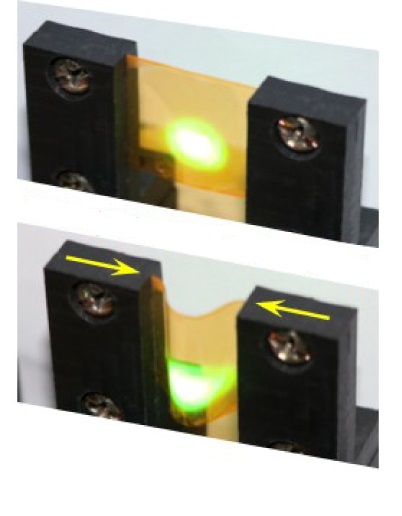
Disorder is emerging as a strategy for fabricating random laser sources with very promising materials, like perovskites, for which standard laser cavities are not effective, or too expensive. We need however different fabrication protocols and technologies for reducing the laser threshold and controlling its emission. Here we demonstrate an effectively solvent-engineered method for high-quality perovskite thin films on the flexible polyimide substrate. The fractal perovskite thin films exhibit excellent optical properties at room temperature and easily achieve lasing action without any laser cavity above room temperature with a low pumping threshold. The lasing action is also observed in curved perovskite thin films on the flexible substrates. The lasing threshold can be further reduced by increasing the local curvature, which modifies the scattering strengths of the bent thin film. We also show that the curved perovskite lasers are extremely robust with respect to repeated deformations. Because of the low spatial coherence, these curved random laser devices are efficient and durable speckle-free light sources for applications in spectroscopy, bio-imaging, and illumination.
Wang et al. in ACS Nano (2019)
See also …
Graphene oxide photonics
The successful exfoliation of graphite initiated new science in any research field and is employing a huge number of scientists in the world investigating chemical, structural, mechanical and optoelectrical; properties of the atomic-thick sheets of graphene and graphene oxide. Similarly to other carbon-based materials, graphene family have shown exceptional optical responses; and nowadays it is engineered to produce efficient photonic components. In this review we aim to summarize the main results in nonlinear optical response and fluorescence of graphene oxide; moreover, its laser printing is reviewed as a novel promising lithographic technique.
Neda Ghofraniha and Claudio Conti in Journal of Optics
See also …